DOW-UAP-D142

AAWSAP DIRD, Concepts for Extracting Energy from the Quantum Vacuum, April 2010, page 15

One page of a U.S. government record released under PURSUE, shown on its own with its text. The record page has the whole document, its catalog details and the scan.

Page
15 of 57
Agency
Department of War
Released
Release 06, September 18, 2026

Text of page 15

UNCLASSIFIED/ /FOR OFFICIAL USE ONLY 10"7 1018 10•19 S(f.T) / 10-20 Material: W N coil: 2000 a coil: 1 cm b coil: 0.01 cm T: 3 Kelvin 10-21 10*22 10*23 10 10% f (Hz) 10° Figure 4. Theoretical Voltage Spectral Density of a Tungsten Coil To successfully measure the ZPF-induced voltage fluctuations, the requirements of low temperature, large coil, and high frequency must be met. The low-temperature requirement is met by performing the experiment in a cooled dewar. Existing high- quality cryogenic dewars (pumped down to 3 K) and sensitive laboratory instruments are suitable for the measurements. The cold spot in one particular dewar under consideration is cylindrical, 2.5 cm in both diameter and height. The largest coil that can be installed will thus have a coil radius of approximately a = 1 cm. To keep the To keel that linear dimension of the coil small will require a small wire thicknesses, perhaps b = 0.01 cm (gauge 38 AWG). By winding the coil in a number of layers (10 or 12 layers), a large number of turns can be accommodated, perhaps N = 2,000 turns. To minimize ohmic resistance, wire made of tungsten (W) is preferred; however, copper (Cu) is a suitable alternative. Voltage fluctuations in the 100 MHz range are easily detected using commercially available laboratory equipment; hence this experiment could be performed using tungsten without resorting to the more sophisticated Josephson junction techniques required by Koch et al. for their higher frequency measurements. For a copper wire coil, the magnitude of the enhancement effect is reduced somewhat compared to the tungsten results shown in Figure 4. But for frequencies approaching the GHz regime, the radiation resistance enhancement effect in copper wire is still predicted to be over 9 UNCLASSIFIED/ /EOR DEFICIAL USE ONLY

Machine-read (OCR) from the scan by this archive; it can contain errors. The scan is the record.
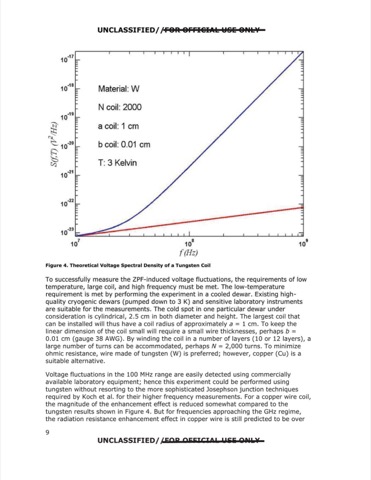
Image from page 15 of DOW-UAP-D142, as released by war.gov
Image from page 15 of the PDF. Open the scan to see the whole page.

Cite this page

U.S. Department of War. "AAWSAP DIRD, Concepts for Extracting Energy from the Quantum Vacuum, April 2010" (DOW-UAP-D142). PURSUE Release 06, U.S. Department of War, September 18, 2026. https://www.war.gov/medialink/ufo/sept-18/release-06/assets/DOW-UAP-D142_AAWSAP-DIRD-Concepts-for-Extracting-Energy-from-the-Quantum-Vacuum-April-6-2010.pdf. Declassified UAP, page 15, https://declassifieduap.org/r/dow-uap-d142-aawsap-dird-concepts-for-extracting-energy-from-the-quantum-vacuum-april-2010/p/15. Accessed November 28, 2026.

This address shows page 15 on its own; /r/dow-uap-d142-aawsap-dird-concepts-for-extracting-energy-from-the-quantum-vacuum-april-2010?page=15 opens the same page in the full reader. Both stay. How to cite.