DOW-UAP-D142

AAWSAP DIRD, Concepts for Extracting Energy from the Quantum Vacuum, April 2010, page 14

One page of a U.S. government record released under PURSUE, shown on its own with its text. The record page has the whole document, its catalog details and the scan.

Page
14 of 57
Agency
Department of War
Released
Release 06, September 18, 2026

Text of page 14

UNCLASSIFIED//FOR OFFFETAL USE ONLY fluctuations). Theoretically, the spectrum of voltage fluctuations, So,1), of a resistive circuit is given by (Reference 21): S(co,T) = R(o,T) ho - coth 2 (247) (2) where Ro,T) is the total resistance (ohmic plus radiative), ∞ is the (angular) frequency, and T is the absolute temperature. The resistance Ro, T) is temperature dependent through its ohmic contribution. Note the similar hyperbolic cotangent functions appearing in Equation (2) and in the second line of Equation (1). The postulate of Blanco et al. is that the total resistance must include the radiation resistance of the circuit (Reference 21): R(oT) = Rohmic (co, 7) + Rrad (0) (3) Under the assumption that the wavelengths of the ZPF modes of interest are larger than the dimensions of the circuit, the radiation resistance of a coil is given by (Reference 21): 2 T N2 3 C ao (4) where N is the number of coil turns, and a is the radius of the coil winding. According to Blanco et al., large enhancements in ZPF-induced voltage fluctuations are possible. By reducing the temperature to minimize ohmic resistance, making the coil of many turns and large radius, and performing measurements at high frequency, it should be possible to investigate this amplification effect. The predicted coil-enhanced voltage spectrum can readily be computed. The result is shown in Figure 4 for a 1 cm diameter coil of 2000 turns, made of 38 AWG tungsten wire, and kept at a temperature of 3 K. In Figure 4, the upper (blue) curve represents the predicted voltage spectral density for the combined ohmic plus radiation resistance. The lower (red) curve is the predicted result when radiation resistance is ignored. If the postulate of Blanco et al. is correct, the enhancement in voltage fluctuations due to the antenna-like nature of the coil should be easily measured at frequencies as low as 100 MHz (where the coil enhancement effect is ~ 100-fold for tungsten). 6 The radiation resistance depends only on frequency. 8 UNCLASSIFIED/ /EOR OFFICIAL USE ONLY

Machine-read (OCR) from the scan by this archive; it can contain errors. The scan is the record.
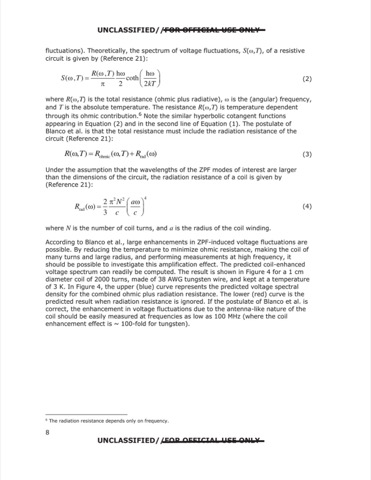
Image from page 14 of DOW-UAP-D142, as released by war.gov
Image from page 14 of the PDF. Open the scan to see the whole page.

Cite this page

U.S. Department of War. "AAWSAP DIRD, Concepts for Extracting Energy from the Quantum Vacuum, April 2010" (DOW-UAP-D142). PURSUE Release 06, U.S. Department of War, September 18, 2026. https://www.war.gov/medialink/ufo/sept-18/release-06/assets/DOW-UAP-D142_AAWSAP-DIRD-Concepts-for-Extracting-Energy-from-the-Quantum-Vacuum-April-6-2010.pdf. Declassified UAP, page 14, https://declassifieduap.org/r/dow-uap-d142-aawsap-dird-concepts-for-extracting-energy-from-the-quantum-vacuum-april-2010/p/14. Accessed November 28, 2026.

This address shows page 14 on its own; /r/dow-uap-d142-aawsap-dird-concepts-for-extracting-energy-from-the-quantum-vacuum-april-2010?page=14 opens the same page in the full reader. Both stay. How to cite.