Text of page 21
UNCLASSIFIED/ LEOR OFFICIAL USE ONET
devices may not be appropriate in the aerospace context because of their large size,
power requirements, large magnetic coils, and so forth.
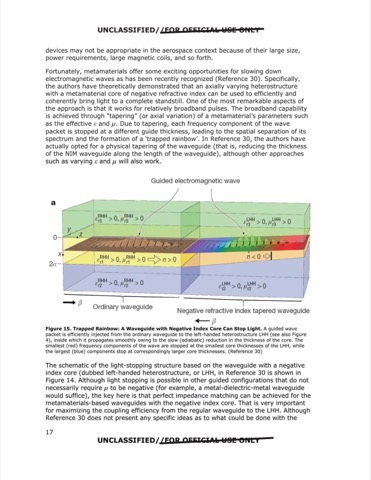
Fortunately, metamaterials offer some exciting opportunities for slowing down
electromagnetic waves as has been recently recognized (Reference 30). Specifically,
the authors have theoretically demonstrated that an axially varying heterostructure
with a metamaterial core of negative refractive index can be used to efficiently and
coherently bring light to a complete standstill. One of the most remarkable aspects of
the approach is that it works for relatively broadband pulses. The broadband capability
is achieved through "tapering" (or axial variation) of a metamaterial's parameters such
as the effective & and u. Due to tapering, each frequency component of the wave
packet is stopped at a different guide thickness, leading to the spatial separation of its
spectrum and the formation of a 'trapped rainbow'. In Reference 30, the authors have
actually opted for a physical tapering of the waveguide (that is, reducing the thickness
of the NIM waveguide along the length of the waveguide), although other approaches
such as varying & and u will also work.
Guided electromagnetic wave
a
У
Z
0
X+
2а-
n < 0 5
СН > О, ИНН > 0
Ordinary waveguide
Negative refractive index tapered waveguide
+ B
Figure 15. Trapped Rainbow: A Waveguide with Negative Index Core Can Stop Light. A guided wave
packet is efficiently injected from the ordinary waveguide to the left-handed heterostructure LHH (see also Figure
4), inside which it propagates smoothly owing to the slow (adiabatic) reduction in the thickness of the core. The
smallest (red) frequency components of the wave are stopped at the smallest core thicknesses of the LHH, while
the largest (blue) components stop at correspondingly larger core thicknesses. (Reference 30)
The schematic of the light-stopping structure based on the waveguide with a negative
index core (dubbed left-handed heterostructure, or LHH, in Reference 30 is shown in
Figure 14. Although light stopping is possible in other guided configurations that do not
necessarily require u to be negative (for example, a metal-dielectric-metal waveguide
would suffice), the key here is that perfect impedance matching can be achieved for the
metamaterials-based waveguides with the negative index core. That is very important
for maximizing the coupling efficiency from the regular waveguide to the LHH. Although
Reference 30 does not present any specific ideas as to what could be done with the
17
UNCLASSIFIED/LEOR OFFICIAL USE ONL