DOW-UAP-D141

AAWSAP DIRD, Metamaterials for Aerospace Applications, April 2010, page 16

One page of a U.S. government record released under PURSUE, shown on its own with its text. The record page has the whole document, its catalog details and the scan.

Page
16 of 38
Agency
Department of War
Released
Release 06, September 18, 2026

Text of page 16

UNCLASSIFIED/ HFOR OF ALICE ONLY a Dotector Far-field FS 100 x Objective FSL Amplitude d Near field Figure 9. FSL Based on an Indefinite Permittivity Metamaterial Placed Between the Object and the Image-Releasing Grating. The grating releases into the far field sub-diffraction waves produced by light scattering off the object. The role of the metamaterial is to propagate sub-diffraction waves from object to grating. (Reference 27) Ever since Merlin's invention (Reference 28) of the sub-diffraction near-field plate, it has become clear that the interference between sub-diffraction electromagnetic fields can result in the formation of a deeply sub-wavelength image. The near-field plate, however, is not an imaging device; its purpose is to create a well-defined image using an elaborate pre-fabricated sub-wavelength structure on the plate's surface. The goal for this study is to observe an a priori unknown sub-wavelength image using a near- field structure. In the past, successes (Reference 19) in retrieving images of sub- wavelength objects (such as N/20 holes) using an NSOM for radiation detection are achieved. An NSOM is a near-field instrument, therefore, a much more desirable detection method would involve far-field detection. To advance this goal, and to develop a tool sometimes referred to as the FSL, we've initiated research on multi- beam multi-detector sub-wavelength holography illustrated in Figure 10. Detectors Far field 2л D = kz 4л D D Indefinite Permittivity Medium 1st order 2-nd order 7 → 2w/c 4T/D Beam A Beam B Figure 10. Tomographic Multi-Beam Multi-Detector Holography of Sub-Wavelength Objects Using Indefinite Permittivity Medium (IPM). Incident beam(s) scatter off the sub-A object, propagate through the IPM, and then get re-scattered into the far field by the grating with the period D. The purpose of the multi-detector arrangement is to disentangle the ki and kz spatial wave numbers in the object's spectrum (shown in the left panel). Beams A and B are phase-shifted with respect to each other. 12 UNCLASSIFIED/ LEOR OFFICE AL USE ONL

Machine-read (OCR) from the scan by this archive; it can contain errors. The scan is the record.
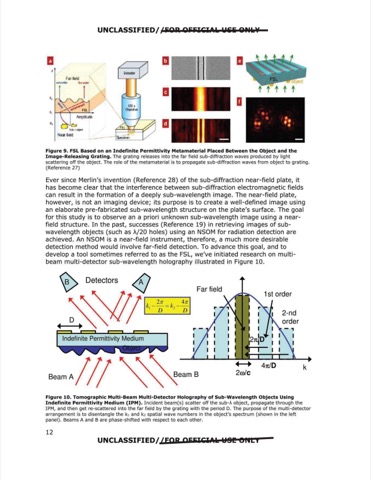
Image from page 16 of DOW-UAP-D141, as released by war.gov
Image from page 16 of the PDF. Open the scan to see the whole page.

Cite this page

U.S. Department of War. "AAWSAP DIRD, Metamaterials for Aerospace Applications, April 2010" (DOW-UAP-D141). PURSUE Release 06, U.S. Department of War, September 18, 2026. https://www.war.gov/medialink/ufo/sept-18/release-06/assets/DOW-UAP-D141_AAWSAP-DIRD-Metamaterials-for-Aerospace-Applications-April-6-2010.pdf. Declassified UAP, page 16, https://declassifieduap.org/r/dow-uap-d141-aawsap-dird-metamaterials-for-aerospace-applications-april-2010/p/16. Accessed November 28, 2026.

This address shows page 16 on its own; /r/dow-uap-d141-aawsap-dird-metamaterials-for-aerospace-applications-april-2010?page=16 opens the same page in the full reader. Both stay. How to cite.