DOW-UAP-D141

AAWSAP DIRD, Metamaterials for Aerospace Applications, April 2010, page 14

One page of a U.S. government record released under PURSUE, shown on its own with its text. The record page has the whole document, its catalog details and the scan.

Page
14 of 38
Agency
Department of War
Released
Release 06, September 18, 2026

Text of page 14

UNCLASSIFIED/ LEOR OFFICIAL USE ONET Note that the hyper-lens concept does not require employing a bulky near-field scanning optical microscope. However, the practical implementation of the hyper-lens is by no means simple. The original implementation required depositing the sample on the curved surface of the hyper-lens. A more practical implementation of the super-lens has been theoretically proposed by another group (Reference 26). The concept is shown in Figure 8. The hyper-lens involves an array of thin metallic wires converging towards the tip. As is demonstrated, a dense array of metal wires separated by much less than the wavelength constitutes a metamaterial with the indefinite permittivity tensor. Specifically, the tensor component along the wires is given by: (3) where the z component is along the wires and perpendicular direction is normal to the wires. Because the only propagating waves are the TEM waves satisfying the c = k°c* dispersion relation, this meta-medium is strongly anisotropic and supports sub-wavelength waves which perform imaging. The spatial resolution is given by the spacing between wires. Figure 8 (right panel) shows the magnified image of a small (1/25) object placed at the tip of the hyper-lens. The magnification factor is 5x. 30 25. 20 15. 10 5.. 0 -5. -10 5 Object image -4 -5 k -5 0 Xilo 5 -5 -5 Figure 8. Hyper-Lens Based on a Converging Array of Metal Wires. A small object can be placed at the tip, illuminated from the top, and magnified by the expanding array of wires. Left panel: schematic. Right panel: 1/25 object magnified by a factor 5x by the expanding hyper-lens. This hyper-lens can operate at mid-IR frequencies. (Reference 26) Another concept for sub-wavelength imaging employing metamaterials is the so-called Far-Field Super-Lens (FSL). The concept is pioneered in Reference 27. The idea is 10 UNCLASSIFIED/ LEOR OFFICIAL USE ONLY

Machine-read (OCR) from the scan by this archive; it can contain errors. The scan is the record.
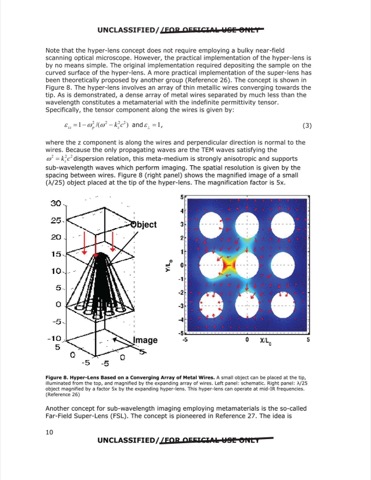
Image from page 14 of DOW-UAP-D141, as released by war.gov
Image from page 14 of the PDF. Open the scan to see the whole page.

Cite this page

U.S. Department of War. "AAWSAP DIRD, Metamaterials for Aerospace Applications, April 2010" (DOW-UAP-D141). PURSUE Release 06, U.S. Department of War, September 18, 2026. https://www.war.gov/medialink/ufo/sept-18/release-06/assets/DOW-UAP-D141_AAWSAP-DIRD-Metamaterials-for-Aerospace-Applications-April-6-2010.pdf. Declassified UAP, page 14, https://declassifieduap.org/r/dow-uap-d141-aawsap-dird-metamaterials-for-aerospace-applications-april-2010/p/14. Accessed November 28, 2026.

This address shows page 14 on its own; /r/dow-uap-d141-aawsap-dird-metamaterials-for-aerospace-applications-april-2010?page=14 opens the same page in the full reader. Both stay. How to cite.