Text of page 13
UNCLASSIFIED/TTON OFTT
AL USL ONLT
Despite the convenience of the near-field super-lens, (that is, its ability to transport the
image) it still requires an NSOM to read out the image. Within the confines of an
advanced aerospace platform such device (with its necessary auxiliaries) may not fit.
Therefore, one has to consider alternative metamaterials-based ideas for sub-diffraction
imaging. One such idea, the hyper-lens, has been proposed recently by two groups
(References 22-24), and already experimentally tested by another group (Reference
25). The principle of the hyper-lens is very simple: to use an indefinite permittivity
medium (sometimes referred to as the hyperbolic medium because the relationship
between the propagation wavenumbers and the frequency, also known as the constant
frequency contour, has a hyperbolic nature) in a tapered format. Several conceptual
implementations such as the spoke-like structure and the cylindrical multi-layer
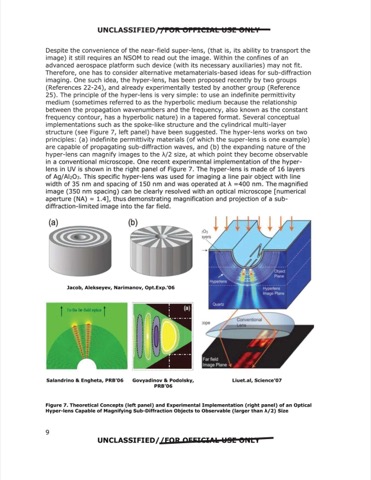
structure (see Figure 7, left panel) have been suggested. The hyper-lens works on two
principles: (a) indefinite permittivity materials (of which the super-lens is one example)
are capable of propagating sub-diffraction waves, and (b) the expanding nature of the
hyper-lens can magnify images to the 1/2 size, at which point they become observable
in a conventional microscope. One recent experimental implementation of the hyper-
lens in UV is shown in the right panel of Figure 7. The hyper-lens is made of 16 layers
of Ag/Al203. This specific hyper-lens was used for imaging a line pair object with line
width of 35 nm and spacing of 150 mm and was operated at ^ =400 mm. The magnified
image (350 nm spacing) can be clearly resolved with an optical microscope [numerical
aperture (NA) = 1.4], thus demonstrating magnification and projection of a sub-
diffraction-limited image into the far field.
a
.Оз
ayers
Hyperions
Jacob, Alekseyev, Narimanov, Opt.Exp.'06
Object
Plane
Hyperlens
Image Plane
Quarte
To the far-field optics
(a)
sope
Conventional
Lens
Far field
Image Plane
Salandrino & Engheta, PRB'06 Govyadinov & Podolsky,
PRB'06
Liuet.al, Science'07
Figure 7. Theoretical Concepts (left panel) and Experimental Implementation (right panel) of an Optical
Hyper-lens Capable of Magnifying Sub-Diffraction Objects to Observable (larger than N/2) Size
9
UNCLASSIFIED/ LEOR OFFICIAL USE ONLY