DOW-UAP-D140

AAWSAP DIRD, High-Frequency Gravitational Wave Communications, April 2010, page 32

One page of a U.S. government record released under PURSUE, shown on its own with its text. The record page has the whole document, its catalog details and the scan.

Page
32 of 57
Agency
Department of War
Released
Release 06, September 18, 2026

Text of page 32

UNCLASSIFIED// FOR OFFIC TAL USE ONLY device. Therefore mobile devices, such as portable remote spaceborne terminals could be typical users of such a navigational service. An example is depicted in Figure 19. (60/-150) (60,120) (-30,-60) (-30,30) Figure 19. HFGW Supplemented Remote Terminal Design The navigational sensitivity of the HFGW receiver would depend on the frequencies used in the HFGW FTS system, as the received CW HFGW signal would act as the remote terminal's "built-in" frequency standard, replacing the need for internal crystal oscillators or Cesium or Rubidium standards. An HFGW FTS carrier wave with a frequency of 300 GHz with a wavelength of 1 mm would result in 3 pico-second type time accuracy. The use of TDOA with these accuracies would allow for arbitrarily small navigational errors. 3.3.1 Improvements Accruing from a HFGW Time Standard The cost of the FTS infrastructure must be more than balanced by the benefit resulting from that infrastructure if the cost is to be justified. Given that the GPS already provides adequate navigation services for most applications, navigational benefits alone would not justify the cost of an HFGW FTS system. However, in the case of a universal HFGW FTS, there are additional benefits associated with applying the frequency and time standards to standard telecommunications problems. The universal nature of the HFGW frequency and time standards are especially helpful. The following telecommunication benefits of an HFGW FTS system will be described in this section: improvement in acquisition time from search space improvements, improvements in modulation and coding efficiency from phase noise improvements, and improvements in bandwidth efficiency from frequency noise improvements. 27 UNCLASSIFIED/ /EOR OFFICIAL USE ONLT

Machine-read (OCR) from the scan by this archive; it can contain errors. The scan is the record.
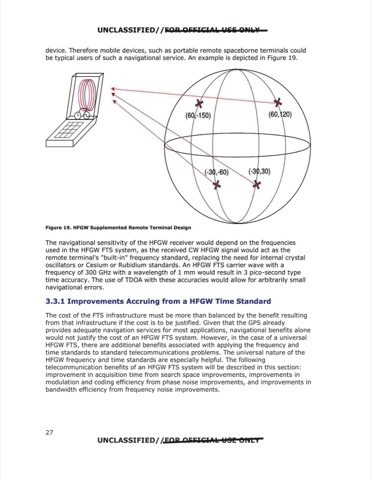
Image from page 32 of DOW-UAP-D140, as released by war.gov
Image from page 32 of the PDF. Open the scan to see the whole page.

Cite this page

U.S. Department of War. "AAWSAP DIRD, High-Frequency Gravitational Wave Communications, April 2010" (DOW-UAP-D140). PURSUE Release 06, U.S. Department of War, September 18, 2026. https://www.war.gov/medialink/ufo/sept-18/release-06/assets/DOW-UAP-D140_AAWSAP-DIRD-High-Frequency-Gravitational-Wave-Communications-April-6-2010.pdf. Declassified UAP, page 32, https://declassifieduap.org/r/dow-uap-d140-aawsap-dird-high-frequency-gravitational-wave-communications-april-2010/p/32. Accessed November 28, 2026.

This address shows page 32 on its own; /r/dow-uap-d140-aawsap-dird-high-frequency-gravitational-wave-communications-april-2010?page=32 opens the same page in the full reader. Both stay. How to cite.