DOW-UAP-D140

AAWSAP DIRD, High-Frequency Gravitational Wave Communications, April 2010, page 31

One page of a U.S. government record released under PURSUE, shown on its own with its text. The record page has the whole document, its catalog details and the scan.

Page
31 of 57
Agency
Department of War
Released
Release 06, September 18, 2026

Text of page 31

UNCLASSIFIED// FOR OFFIC AL USE ONLY of the ground stations, shown in Figure 18 where their latitude and longitude are given in parentheses. (60,-150), (60,120) Large HFGW Transmitter Ground Stations (-30,-60) (-30,30) Figure 18. A Proposed Near-Earth Distribution of Frequency Time Standard The large transmitter ground stations would provide the signals used as both the frequency and time standards. All FTS ground stations would be synchronized such that they emit signals exactly in phase with each other, all tied to a common frequency time source, such as the US Naval Observatory. Each station would use a different frequency such that the remote terminal (RT) user set could easily differentiate signals, and any phase or time difference observed would be due to either the relative position of the remote terminal with respect to each ground station, or the relative velocity of the remote terminal with respect to each ground station. Each ground station would transmit both a carrier wave (CW) signal for a frequency reference and a periodic pulse signal (PPS) for a time reference. At least 3 ground stations would be needed for self- triangulation by the remote terminals, at least 4 with redundancy. HFGWs will propagate through the Earth with little modification, but very slight HFGW phase modification may be observed in surveillance applications (Baker, 2007.) The counterpart to the fixed ground infrastructure would be the remote terminal side or user side of the FTS infrastructure. Each remote terminal would need to be equipped with a small HFGW receiver, which could pickup all 3 or 4 ground stations simultaneously. The arrival times of the received PPS signals could be compared via time difference of arrival, or TDOA, and used to develop a position estimate. The CW signal phases could be compared to determine the Doppler velocity of the remote terminal with respect to an Earth Centered Inertial (ECI) coordinate system. Thus, the HFGW FTS system could be used as a navigational aid, akin to the GPS system. This end of the infrastructure would be receive only and could therefore be a very low power 26 UNCLASSIFIED/ /EOR OFFICIAL USE ONLT

Machine-read (OCR) from the scan by this archive; it can contain errors. The scan is the record.
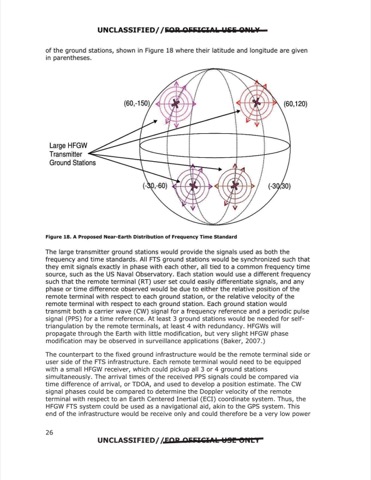
Image from page 31 of DOW-UAP-D140, as released by war.gov
Image from page 31 of the PDF. Open the scan to see the whole page.

Cite this page

U.S. Department of War. "AAWSAP DIRD, High-Frequency Gravitational Wave Communications, April 2010" (DOW-UAP-D140). PURSUE Release 06, U.S. Department of War, September 18, 2026. https://www.war.gov/medialink/ufo/sept-18/release-06/assets/DOW-UAP-D140_AAWSAP-DIRD-High-Frequency-Gravitational-Wave-Communications-April-6-2010.pdf. Declassified UAP, page 31, https://declassifieduap.org/r/dow-uap-d140-aawsap-dird-high-frequency-gravitational-wave-communications-april-2010/p/31. Accessed November 28, 2026.

This address shows page 31 on its own; /r/dow-uap-d140-aawsap-dird-high-frequency-gravitational-wave-communications-april-2010?page=31 opens the same page in the full reader. Both stay. How to cite.