DOW-UAP-D136

AAWSAP DIRD, Biosensors and BioMEMS: A Survey of the Present Field, March 2010, page 44

One page of a U.S. government record released under PURSUE, shown on its own with its text. The record page has the whole document, its catalog details and the scan.

Page
44 of 45
Agency
Department of War
Released
Release 06, September 18, 2026

Text of page 44

UNCLASSIFIED//To USE ONL Thus the trend has been to employ MEMS technology to reduce the size of the cantilever beams to microscopic proportions. In such cases, even the mass of cells or virus particles can be measured. Figure 35 shows a microcantilever system that is on the order of one micron in width and 10 microns in length. This cantilever beam was used as a mass detector, with sensitivity to a single vaccinia virus particle (vaccinia virus forms the basis of the smallpox vaccine). Vaccinia Virus Particles Cantilever Beam Biomolecular sensors with the ability to "multiplex," or to detect a large number of different molecular species at the same time, are being developed for cancer diagnostics and therapy monitoring. 1um Figure 35. Scanning Electron Micrograph Showing a Cantilever Beam With a Single Vaccinia Virus Particle The secret to good performance is finding a coating that has a high sensitivity for a specific material of interest. Antibodies are often used as coatings since they can be tailored to bind to many different molecules. Even so, there are often problems of antibody shelf-life and they are not perfectly specific and so experience interference from other chemicals in the test sample. Figure 36 illustrates the affinity coating. Antibodies for different proteins are coated onto different micro-cantilever beams, making each beam a sensor. b Tumour biomarker proteins Antibody Bent cantilever Figure 36. Antibodies Attached to a Cantilever Array Create Different Specificities to Substances in Blood That are Indicative of Cancer 38 UNCLASSIFIED/ LEOR OFFICIAL LISE ONLY

Machine-read (OCR) from the scan by this archive; it can contain errors. The scan is the record.
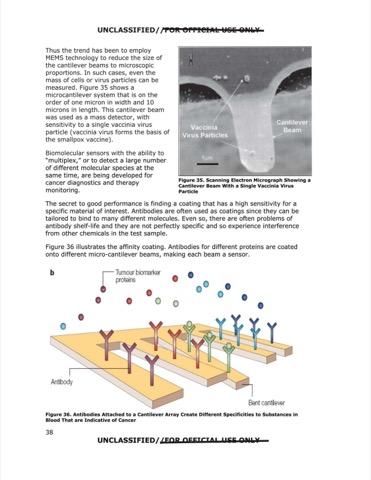
Image from page 44 of DOW-UAP-D136, as released by war.gov
Image from page 44 of the PDF. Open the scan to see the whole page.

Cite this page

U.S. Department of War. "AAWSAP DIRD, Biosensors and BioMEMS: A Survey of the Present Field, March 2010" (DOW-UAP-D136). PURSUE Release 06, U.S. Department of War, September 18, 2026. https://www.war.gov/medialink/ufo/sept-18/release-06/assets/DOW-UAP-D136_AAWSAP-DIRD-Biosensors-and-BioMEMS-A-Survey-of-the-Present-Field-March-31-2010.pdf. Declassified UAP, page 44, https://declassifieduap.org/r/dow-uap-d136-aawsap-dird-biosensors-and-biomems-a-survey-of-the-present-field-march-2010/p/44. Accessed November 28, 2026.

This address shows page 44 on its own; /r/dow-uap-d136-aawsap-dird-biosensors-and-biomems-a-survey-of-the-present-field-march-2010?page=44 opens the same page in the full reader. Both stay. How to cite.