DOW-UAP-D136

AAWSAP DIRD, Biosensors and BioMEMS: A Survey of the Present Field, March 2010, page 43

One page of a U.S. government record released under PURSUE, shown on its own with its text. The record page has the whole document, its catalog details and the scan.

Page
43 of 45
Agency
Department of War
Released
Release 06, September 18, 2026

Text of page 43

UNCLASSIFIED//TOR OFFTETAL USE ONLY Microcantilever based sensors fall into two categories: static sensors and vibrational sensors. Static sensing microcantilevers are usually covered with a gold film, which is then coated with a substance having a specific affinity. Upon binding the specific analyte (such as a protein), stress is generated resulting in bending of the microcantilever. selective chemical layer • h L S The deflection is often measured using a narrow light beam from a small laser. reacting chemical compound Light reflected off the bottom of the cantilever falls onto a surface, where a position sensitive detector (PSD) can determine how much the beam bends. Figure 34. Principle of a Microcantilever That Bends When It is Loaded With an Adherent Mass Typically the bend is exceedingly slight, but the sensitivity of the optical readout system is high enough that small amounts (nanograms to picograms) of adsorbed material can be detected. These devices are mostly used for measuring things in the air and not well suited for immersion in fluids. In vibrational sensing, an external motor is used to vibrate the microcantilever through a certain range of speeds, and a sensing mechanism then reads out the amplitude of the vibration. By seeing at what speed the cantilever vibrates best, the resonant frequency is obtained. As bioparticles bind to the microcantilever, the resonant frequency will be slower due to the increased mass. The mass of attached analyte can be determined from the frequency of the microcantilever. The microcantilever has its own natural frequency w. When a biomolecule binds to the microcantilever, it changes the mass of the microcantilever. This in turn affects the resonant frequency. We can use that change to determine the mass that has been attached to the microcantilever. In some sense it is like a tuning fork that changes its pitch when touched. The surface has an affinity for adhesion of a certain material and nothing else. When these materials are present, they adhere and increase the mass and so the pitch moves lower. The sensitivity of these systems to the loaded mass increases as the mass of the cantilever beam decreases and with it the resonant frequency increases. Decreasing the overall dimensions of the beam results in an corresponding increase in their sensitivity. 37 UNCLASSIFIED/ LEOR OFFICIAL LISE ONLY

Machine-read (OCR) from the scan by this archive; it can contain errors. The scan is the record.
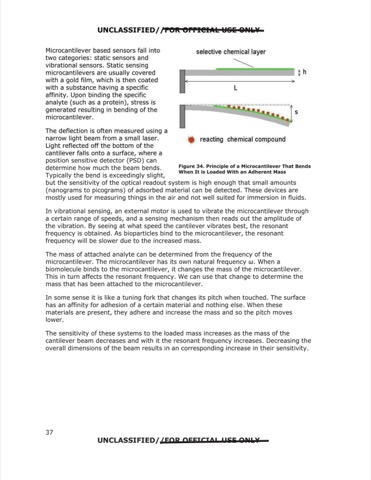
Image from page 43 of DOW-UAP-D136, as released by war.gov
Image from page 43 of the PDF. Open the scan to see the whole page.

Cite this page

U.S. Department of War. "AAWSAP DIRD, Biosensors and BioMEMS: A Survey of the Present Field, March 2010" (DOW-UAP-D136). PURSUE Release 06, U.S. Department of War, September 18, 2026. https://www.war.gov/medialink/ufo/sept-18/release-06/assets/DOW-UAP-D136_AAWSAP-DIRD-Biosensors-and-BioMEMS-A-Survey-of-the-Present-Field-March-31-2010.pdf. Declassified UAP, page 43, https://declassifieduap.org/r/dow-uap-d136-aawsap-dird-biosensors-and-biomems-a-survey-of-the-present-field-march-2010/p/43. Accessed November 28, 2026.

This address shows page 43 on its own; /r/dow-uap-d136-aawsap-dird-biosensors-and-biomems-a-survey-of-the-present-field-march-2010?page=43 opens the same page in the full reader. Both stay. How to cite.