DOW-UAP-D136

AAWSAP DIRD, Biosensors and BioMEMS: A Survey of the Present Field, March 2010, page 36

One page of a U.S. government record released under PURSUE, shown on its own with its text. The record page has the whole document, its catalog details and the scan.

Page
36 of 45
Agency
Department of War
Released
Release 06, September 18, 2026

Text of page 36

UNCLASSIFIED//TOR ONL Chip and dectrade artay connected 1o Coil see ned igurel Recoting Col for data and power CCO Transmession Col for dals and pover (wire los transmiss lord Minisure camera mourited on a pair of girages dands avage do transmission CciD Figure 27. Power Transfer by Magnetic Induction to an Implanted BioMEMS Retinal Prosthesis. This is the Boston Retinal Implant Project. (http://www.bostonretinalimplant.org/retinalapproach.php?fontsize=normal&hicontrast) MICROSCALE IN THERAPEUTIC NEUROSTIMULATION Some of the biggest excitement in medical neuroprosthetics has been in the notion that we can use micro-implantable devices rather than drugs to reduce or better control the effects of stroke, heart disease, epilepsy, and other disorders of the human condition. Bioelectrical stimulation has effects which are very specific on local tissues rather than indiscriminately affecting all tissues and so may offer fewer side effects of drugs. Such devices can be finely controlled in their effects and provide a greater flexibility in terms of treatment. Any implanted device has to be small in order to be minimally invasive, especially in the brain. Powering of implanted devices by batteries is only practical in a few biomedical situations. Also implants may need to communicate with the outside world wirelessly. Having wires penetrating the skin is uncomfortable and could lead to infection in the tissue. The notion of placing bioelectronic stimulation devices inside of the body for therapeutic reasons goes back to the early invention of the pacemaker. These kind of devices have internal batteries to support an electrical pulse generator that paces the rhythm of the heart. Because the amount of energy in each pulse is relatively small the power drain is low and the pacemaker batteries can last years. The difficulty is that they are bulky, must be eventually replaced on the order of seven years, and their placement is invasive. 30 UNCLASSIFIED/ LEOR OFFICIAL LISE ONLY

Machine-read (OCR) from the scan by this archive; it can contain errors. The scan is the record.
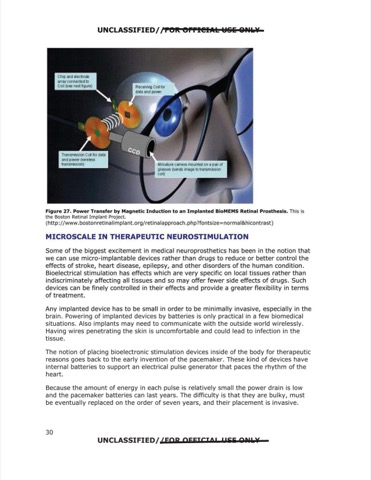
Image from page 36 of DOW-UAP-D136, as released by war.gov
Image from page 36 of the PDF. Open the scan to see the whole page.

Cite this page

U.S. Department of War. "AAWSAP DIRD, Biosensors and BioMEMS: A Survey of the Present Field, March 2010" (DOW-UAP-D136). PURSUE Release 06, U.S. Department of War, September 18, 2026. https://www.war.gov/medialink/ufo/sept-18/release-06/assets/DOW-UAP-D136_AAWSAP-DIRD-Biosensors-and-BioMEMS-A-Survey-of-the-Present-Field-March-31-2010.pdf. Declassified UAP, page 36, https://declassifieduap.org/r/dow-uap-d136-aawsap-dird-biosensors-and-biomems-a-survey-of-the-present-field-march-2010/p/36. Accessed November 28, 2026.

This address shows page 36 on its own; /r/dow-uap-d136-aawsap-dird-biosensors-and-biomems-a-survey-of-the-present-field-march-2010?page=36 opens the same page in the full reader. Both stay. How to cite.