DOW-UAP-D136

AAWSAP DIRD, Biosensors and BioMEMS: A Survey of the Present Field, March 2010, page 35

One page of a U.S. government record released under PURSUE, shown on its own with its text. The record page has the whole document, its catalog details and the scan.

Page
35 of 45
Agency
Department of War
Released
Release 06, September 18, 2026

Text of page 35

UNCLASSIFIED//TOR L USE ONLY Figure 26. An Illustration of the Retinal Neuroprosthesis Created by the Boston Implant Project (http://www.bostonretinalimplant.org/implant.php?fontsize=normal&hicontrast) The signal processing circuits are on the left while the power induction coil is the circular structure. The MEMS stimulating microelectrode array projects out towards the bottom of the picture. The minimal size of the implant means batteries are impractical and forms of wireless power by magnetic induction, ultrasound, or solar energy are required. In addition the tissue surrounding the implant is usually very sensitive to temperature rise so the implant must have very low power consumption to ensure it will not harm the tissue. Power by magnetic induction is widely used because it allows relatively larger amounts of power transfer compared to ultrasound and solar energy techniques. Parallel coils of wire, one inside the body and one outside, exchange energy by magnetic field coupling in accordance with Faraday's law of induction. Figure 27 is an artist's conception of the magnetic induction method of power transmission. There are two coaxial coils that couple magnetically, one on the inside of the body and one external. The energy of the magnetic field is shown as the curved lines passing through the tissue. A disadvantage of this method is that the coils are relatively large compared to the size of micro-implants and so tends to define the minimum size. The coil size depends on the amount of energy that needs to be induced and on the implant depth with larger diameter coils being required. This type of technology is giving way to improved methods of energy transmission into tissue for implant power by using microscale devices that, although not strictly MEMS, share many of their characteristics. 29 UNCLASSIFIED/ LEOR OFFICIAL USE ONLY

Machine-read (OCR) from the scan by this archive; it can contain errors. The scan is the record.
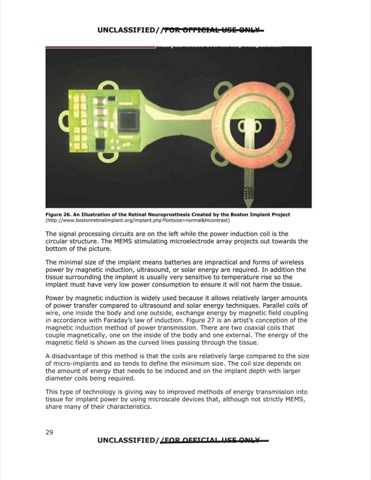
Image from page 35 of DOW-UAP-D136, as released by war.gov
Image from page 35 of the PDF. Open the scan to see the whole page.

Cite this page

U.S. Department of War. "AAWSAP DIRD, Biosensors and BioMEMS: A Survey of the Present Field, March 2010" (DOW-UAP-D136). PURSUE Release 06, U.S. Department of War, September 18, 2026. https://www.war.gov/medialink/ufo/sept-18/release-06/assets/DOW-UAP-D136_AAWSAP-DIRD-Biosensors-and-BioMEMS-A-Survey-of-the-Present-Field-March-31-2010.pdf. Declassified UAP, page 35, https://declassifieduap.org/r/dow-uap-d136-aawsap-dird-biosensors-and-biomems-a-survey-of-the-present-field-march-2010/p/35. Accessed November 28, 2026.

This address shows page 35 on its own; /r/dow-uap-d136-aawsap-dird-biosensors-and-biomems-a-survey-of-the-present-field-march-2010?page=35 opens the same page in the full reader. Both stay. How to cite.