DOW-UAP-D136

AAWSAP DIRD, Biosensors and BioMEMS: A Survey of the Present Field, March 2010, page 22

One page of a U.S. government record released under PURSUE, shown on its own with its text. The record page has the whole document, its catalog details and the scan.

Page
22 of 45
Agency
Department of War
Released
Release 06, September 18, 2026

Text of page 22

UNCLASSIFIED//TOR OFf TETAL USE ONLY released chemical energy warms the surrounding environment to a degree that depends on the energy released in the exothermic reaction, which is characteristic of the particular chemistry and the amount of reactants. The heating is then dependent on the glucose concentration. Figure 12 shows these devices. They are made by MEMS techniques involving the processes of using patterning by exposure to light through a mask (photolithography), metal deposition by evaporation, and sputter etching. The result is the fabrication of sensors in large arrays with many identical sensors on a single substrate. The figure is a photomicrograph of a part of a wafer production run with nine identical devices. Each one of the devices is less than 1 mm in size and would be cut apart and used independently. The darker rectangular areas at the top of each device are the electrical bonding pads where wires attach to the device to readout its electrical response. Figure 13 shows the basic process in the Figure 12. Photomicrograph 3 x 3 Array of sensor operation. The sensor is planar Thermoelectric Glucose Sensors Constructed by and composed of a layered structure Towe et al. at ASU consisting of an enzyme gel and a thermoelectric temperature sensor. Glucose from the local medium naturally diffuses to the gel and the temperature sensor underlies a thin film of enzyme gel that contains the glucose oxidase. A second enzyme called catalase is used to secondarily break down hydrogen peroxide produced by the first reaction. 16 UNCLASSIFIED / LEOR OFFICIAL USE ONLY

Machine-read (OCR) from the scan by this archive; it can contain errors. The scan is the record.
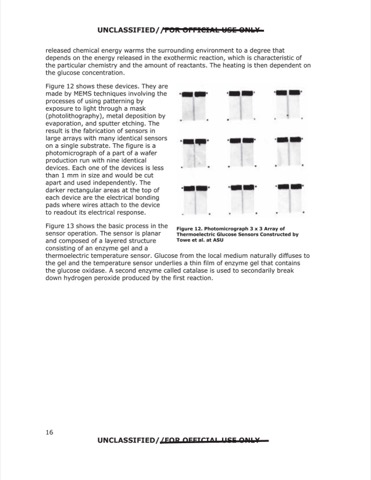
Image from page 22 of DOW-UAP-D136, as released by war.gov
Image from page 22 of the PDF. Open the scan to see the whole page.

Cite this page

U.S. Department of War. "AAWSAP DIRD, Biosensors and BioMEMS: A Survey of the Present Field, March 2010" (DOW-UAP-D136). PURSUE Release 06, U.S. Department of War, September 18, 2026. https://www.war.gov/medialink/ufo/sept-18/release-06/assets/DOW-UAP-D136_AAWSAP-DIRD-Biosensors-and-BioMEMS-A-Survey-of-the-Present-Field-March-31-2010.pdf. Declassified UAP, page 22, https://declassifieduap.org/r/dow-uap-d136-aawsap-dird-biosensors-and-biomems-a-survey-of-the-present-field-march-2010/p/22. Accessed November 28, 2026.

This address shows page 22 on its own; /r/dow-uap-d136-aawsap-dird-biosensors-and-biomems-a-survey-of-the-present-field-march-2010?page=22 opens the same page in the full reader. Both stay. How to cite.