DOW-UAP-D134

AAWSAP DIRD, Maverick Inventor Versus Corporate Inventor: Where Will the Next Major Innovations Arise, March 2010, page 8

One page of a U.S. government record released under PURSUE, shown on its own with its text. The record page has the whole document, its catalog details and the scan.

Page
8 of 19
Agency
Department of War
Released
Release 06, September 18, 2026

Text of page 8

UNCLASSIFIED H/FOR OFFICIAL USE ONLY Table 1. Types and Examples of Think Tanks Type Universities Government Quasi-Government/Military Corporate Privately Funded Independent, Nonprofit Examples Radlab, MIT, Cambridge, MA Sandia National Laboratories, Albuquerque, NM Lawrence Livermore National Laboratory, Livermore, CA Brookhaven National Laboratory, Upton, NASA (for example, Glenn Research Center, Brook Park, OH) DARPA, Arlington, VA GM Research Laboratory, Warren, MI Alcatel/Lucent - Bell Labs, Murray Hill, NJ Skunk Works, Palmdale, CA Perimeter Institute for Theoretical Physics, Waterloo, Canada Institute for Advanced Studies, Austin, TX SARA (Scientific Applications & Research Associates), Cypress, CA Battelle, Columbus, OH SRI International, Menlo Park, CA EPRI (Electric Power Research Institute), Palo Alto, CA Austrian Research Centers, Seibersdorf, Austria These entities typically arose in response to a particular need or crisis. Perhaps the most famous and effective think tank was the vast agency known as the Manhattan District. Less well known to the public was, for example, the RadLab at MIT. Except in the case of privately funded organizations, they all support many hundreds to thousands of researchers, of which a variable proportion could be termed "inventors." Even the smaller entities support a dozen or so highly motivated scientists and engineers easily classified as inventors. A benefit of being an inventor in a large organization is access to information. The corporate inventor can quickly determine whether a certain avenue of approach has 3 UNCLASSIFIED/ /EOR OFFICIAL USE ONLY

Machine-read (OCR) from the scan by this archive; it can contain errors. The scan is the record.
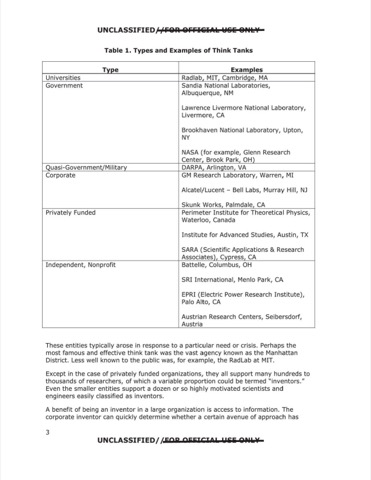
Image from page 8 of DOW-UAP-D134, as released by war.gov
Image from page 8 of the PDF. Open the scan to see the whole page.

Cite this page

U.S. Department of War. "AAWSAP DIRD, Maverick Inventor Versus Corporate Inventor: Where Will the Next Major Innovations Arise, March 2010" (DOW-UAP-D134). PURSUE Release 06, U.S. Department of War, September 18, 2026. https://www.war.gov/medialink/ufo/sept-18/release-06/assets/DOW-UAP-D134_AAWSAP-DIRD-Maverick-Inventor-Versus-Corporate-Inventor-Where-Will-the-Next-Major-Innovations-Arise-March-30-2010.pdf. Declassified UAP, page 8, https://declassifieduap.org/r/dow-uap-d134-aawsap-dird-maverick-inventor-versus-corporate-inventor-where-will-the-next-major-innovations-arise-march-2010/p/8. Accessed November 28, 2026.

This address shows page 8 on its own; /r/dow-uap-d134-aawsap-dird-maverick-inventor-versus-corporate-inventor-where-will-the-next-major-innovations-arise-march-2010?page=8 opens the same page in the full reader. Both stay. How to cite.