DOW-UAP-D134

AAWSAP DIRD, Maverick Inventor Versus Corporate Inventor: Where Will the Next Major Innovations Arise, March 2010, page 7

One page of a U.S. government record released under PURSUE, shown on its own with its text. The record page has the whole document, its catalog details and the scan.

Page
7 of 19
Agency
Department of War
Released
Release 06, September 18, 2026

Text of page 7

UNCLASSIFIED/ FOR OFFICIAL USE ONLY • Individual with formal training and little money. • Individual with formal training and some money. • Small group (usually two or three) of knowledgeable inventors with money. "Formal training" is assumed to be in the specific scientific or engineering discipline in which the invention would naturally be situated. Of course, in the last entry in the above list, the maverick inventor begins to look more like the "corporate inventor," but the idea should be clear. Although this paper does not dwell on the personality of the maverick inventor, it is useful to remind ourselves that the maverick inventor is by definition a loner both in social and scientific/technical areas. In an online article (Reference 3), maverick themselves up and keep going and eventually, every once in a while, one of your ideas actually breaks through and works, and it makes all that stuff seem worthwhile." Kamen's article goes on to state: "Stubborn, delusionally optimistic, creative, fearless, flexible and focused are some of the ways psychologists and business people describe the personality of the maverick... You need to be in denial or in ignorance about the huge challenges you face,' laughs Guy Kawasaki, a former Apple executive and entrepreneur who's starting the self-described "magazine rack" alltop.com. 'You have to believe that it wouldn't be hard for you to succeed.'" Corporate Inventor The corporate inventor is a part of and relies on a large organization, conveniently labeled a think tank, to both stimulate and sustain him. There is constant interaction between like-minded innovators that serves both as a stimulus to explore new areas and as a much-needed "dead-end detector." Usually, sufficient cash and equipment are on hand, especially when the desired innovation is being funded externally. These think tanks may be government, military, academic, corporate, or private. The closest model to the freedom associated with the maverick inventor is usually found in a university setting, although a number of privately sponsored institutions exist (for example, Perimeter Institute in Waterloo, Canada). At least until recently, academic institutions prided themselves in the freedom granted to their research scientists and engineers. Table 1 provides examples of the various types of think tanks. 2 UNCLASSIFIED/*FOR OFFIEIAL USE ONLY

Machine-read (OCR) from the scan by this archive; it can contain errors. The scan is the record.
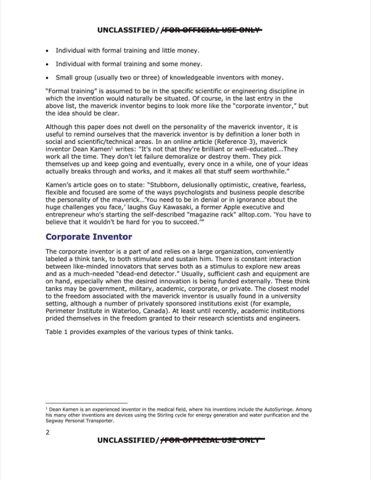
Image from page 7 of DOW-UAP-D134, as released by war.gov
Image from page 7 of the PDF. Open the scan to see the whole page.

Cite this page

U.S. Department of War. "AAWSAP DIRD, Maverick Inventor Versus Corporate Inventor: Where Will the Next Major Innovations Arise, March 2010" (DOW-UAP-D134). PURSUE Release 06, U.S. Department of War, September 18, 2026. https://www.war.gov/medialink/ufo/sept-18/release-06/assets/DOW-UAP-D134_AAWSAP-DIRD-Maverick-Inventor-Versus-Corporate-Inventor-Where-Will-the-Next-Major-Innovations-Arise-March-30-2010.pdf. Declassified UAP, page 7, https://declassifieduap.org/r/dow-uap-d134-aawsap-dird-maverick-inventor-versus-corporate-inventor-where-will-the-next-major-innovations-arise-march-2010/p/7. Accessed November 28, 2026.

This address shows page 7 on its own; /r/dow-uap-d134-aawsap-dird-maverick-inventor-versus-corporate-inventor-where-will-the-next-major-innovations-arise-march-2010?page=7 opens the same page in the full reader. Both stay. How to cite.