DOW-UAP-D132

AAWSAP DIRD, Advanced Space Propulsion Based on Vacuum (Spacetime Metric) Engineering, March 2010, page 7

One page of a U.S. government record released under PURSUE, shown on its own with its text. The record page has the whole document, its catalog details and the scan.

Page
7 of 17
Agency
Department of War
Released
Release 06, September 18, 2026

Text of page 7

UNCLASSIFIED//TOR OFFICIAL USE ONLY with the metric tensor coefficients & modifying the Minkowski flat-spacetime intervals dt, dr, and so forth, accordingly. As another example of spacetime alteration, in a spacetime altered by the presence of a charged spherical mass distribution (Q,m) at the origin (Reissner-Nordstrom-type solution), the above can be transformed into (Reference 11) 1- Gm/ re 1- Gm/ rc Q'G/4 TE, c* 1+ Gm/ re + - ,? (1+ Gm/re?)3 (5) with the metric tensor coefficients guy again changed accordingly. Note that the effect on the metric due to charge Q differs in sign from that due to mass m, leading to what in the literature has been referred to as electrogravitic repulsion (Reference 12). Similar relatively simple solutions exist for a spinning mass (Kerr solution) and for a spinning electrically charged mass (Kerr-Newman solution). In the general case, appropriate solutions for the metric tensor can be generated for arbitrarily engineered spacetimes, characterized by an appropriate set of spacetime variables dx" and metric tensor coefficients guy. Of significance now is to identify the associated physical effects and to develop a table of such effects for quick reference. We begin by simply cataloging metric effects-that is, physical effects associated with alteration of spacetime variables-saving for Section IV the significance of such effects within the context of advanced aerospace craft technologies. II. Physical Effects as a Function of Metric Tensor Coefficients In undistorted spacetime, measurements with physical rods and clocks yield spatial intervals dx" and time intervals dt, defined in a flat Minkowski spacetime, the spacetime of common experience. In spacetime-altered regions, dx" and dt are still chosen as natural coordinate intervals to represent a coordinate map, but now local measurements with physical rods and clocks yield spatial intervals V-8 dx" and time intervals 8mdt, so-called proper coordinate intervals. From these relationships a table of associated physical effects to be expected in spacetime regions altered by either natural or advanced technological means can be generated. Given that, as seen from an unaltered region, alteration of spatial and temporal intervals in a spacetime-altered region result in an altered velocity of light, from an engineering viewpoint such alterations can in essence be understood in terms of a variable refractive index of the vacuum (see Section III below) that affects all measurement. 2 UNCLASSIFIED/ / FOR AL USE ONLT

Machine-read (OCR) from the scan by this archive; it can contain errors. The scan is the record.
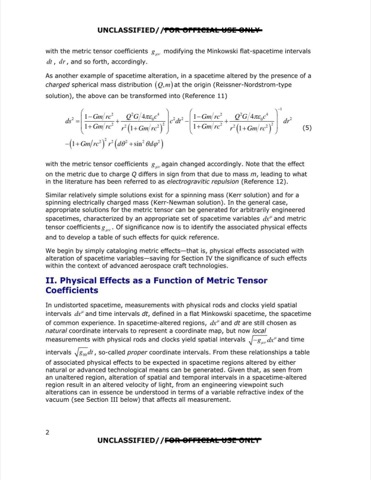
Image from page 7 of DOW-UAP-D132, as released by war.gov
Image from page 7 of the PDF. Open the scan to see the whole page.

Cite this page

U.S. Department of War. "AAWSAP DIRD, Advanced Space Propulsion Based on Vacuum (Spacetime Metric) Engineering, March 2010" (DOW-UAP-D132). PURSUE Release 06, U.S. Department of War, September 18, 2026. https://www.war.gov/medialink/ufo/sept-18/release-06/assets/DOW-UAP-D132_AAWSAP-DIRD-Advanced-Space-Propulsion-Based-on-Vacuum-Spacetime%20Metric-Engineering-March-29-2010.pdf. Declassified UAP, page 7, https://declassifieduap.org/r/dow-uap-d132-aawsap-dird-advanced-space-propulsion-based-on-vacuum-spacetime-metric-engineering-march-2010/p/7. Accessed November 28, 2026.

This address shows page 7 on its own; /r/dow-uap-d132-aawsap-dird-advanced-space-propulsion-based-on-vacuum-spacetime-metric-engineering-march-2010?page=7 opens the same page in the full reader. Both stay. How to cite.