DOW-UAP-D132

AAWSAP DIRD, Advanced Space Propulsion Based on Vacuum (Spacetime Metric) Engineering, March 2010, page 6

One page of a U.S. government record released under PURSUE, shown on its own with its text. The record page has the whole document, its catalog details and the scan.

Page
6 of 17
Agency
Department of War
Released
Release 06, September 18, 2026

Text of page 6

UNCLASSIFIED//FeR eFFICIAL USE ONLY I. Spacetime Modification - Metric Tensor Approach Despite the daunting energy requirements to restructure the spacetime metric to a significant degree, one can investigate the forms that such restructuring would take to be useful for spaceflight applications and determine their corollary attributes and consequences. Thus we embark on a "Blue Sky," general-relativity-for-engineers approach, as it were. As a mathematical evaluation tool, the metric tensor that describes the measurement of spacetime intervals is used. Such an approach, well known from studies in general relativity (GR), has the advantage of being model independent-that is, it does not depend on knowledge of the specific mechanisms or dynamics that result in spacetime alterations but rather only assumes that a technology exists that can control and manipulate (that is, engineer) the spacetime metric to advantage. Before discussing the predicted characteristics of such engineered spacetimes, beginning in Section Ill, a brief mathematical digression for those interested in the mathematical structure behind the discussion to follow is introduced. As a brief introduction, the expression for the four-dimensional line element ds' in terms of the metric tensor g. is given by ds' = 8 dx"dx" (1) where summation over repeated indices is assumed unless otherwise indicated. In ordinary Minkowski flat spacetime, a (four-dimensional) infinitesimal interval ds is given by the expression (in Cartesian coordinates) ds = c dt - (dẻ + dy + dỉ) (2) where the identification dx° = cdt, dx' = dx, dx* = dy, dx* = dz is made, with metric tensor coefficients 800 = 1, 81 = 822 = 833 = -1, 8m = 0 for M#v. For spherical coordinates in ordinary Minkowski flat spacetime ds = d - dr - r dể -r sin' Đdq (3) where ds° = cdt, dx'=dr, dr = de, di = de, with metric tensor coefficients 8∞0 =1, 81 = -1, 822=-12, 833=-f sin' 0, 8m = 0 for u#v. As an example of spacetime alteration, in a spacetime altered by the presence of a spherical mass distribution m at the origin (Schwarzschild-type solution), the above can be transformed into (Reference 10) 1- Gm/ rc ds* = (1+ Gm/ rc 1- Gm/re2)- ở di dr - (1+ Gm/re*),? (de + sin' Odd) (4) 1 + Gm/ rc 1 UNCLASSIFIED//FOR OFFICIAL USE ONLY

Machine-read (OCR) from the scan by this archive; it can contain errors. The scan is the record.
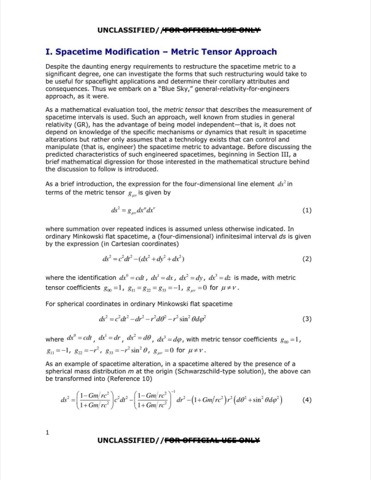
Image from page 6 of DOW-UAP-D132, as released by war.gov
Image from page 6 of the PDF. Open the scan to see the whole page.

Cite this page

U.S. Department of War. "AAWSAP DIRD, Advanced Space Propulsion Based on Vacuum (Spacetime Metric) Engineering, March 2010" (DOW-UAP-D132). PURSUE Release 06, U.S. Department of War, September 18, 2026. https://www.war.gov/medialink/ufo/sept-18/release-06/assets/DOW-UAP-D132_AAWSAP-DIRD-Advanced-Space-Propulsion-Based-on-Vacuum-Spacetime%20Metric-Engineering-March-29-2010.pdf. Declassified UAP, page 6, https://declassifieduap.org/r/dow-uap-d132-aawsap-dird-advanced-space-propulsion-based-on-vacuum-spacetime-metric-engineering-march-2010/p/6. Accessed November 28, 2026.

This address shows page 6 on its own; /r/dow-uap-d132-aawsap-dird-advanced-space-propulsion-based-on-vacuum-spacetime-metric-engineering-march-2010?page=6 opens the same page in the full reader. Both stay. How to cite.