DOW-UAP-D130

AAWSAP DIRD, Technological Approaches to Controlling External Devices, March 2010, page 27

One page of a U.S. government record released under PURSUE, shown on its own with its text. The record page has the whole document, its catalog details and the scan.

Page
27 of 36
Agency
Department of War
Released
Release 06, September 18, 2026

Text of page 27

UNCLASSIFIED// FOR OFFIETAL USE ONLY nOMI Lamprey brainstem Video nOMP Amplifiers PRRN Variable frequency pulse generator From light sensors Cancel artifact - --. Spike detection and low-pass filter To motor actuators 1_2 Synchro Khepera mobile robot Figure 12. A Hybrid Neuro-Robotic System. Signals from the optical sensors of a Khepera (K-team) mobile robot (bottom) are encoded by the interface into electrical stimulations, the frequency of which depends linearly on the light intensity. These stimuli are delivered by tungsten microelectrodes to the right and left vestibular pathways of a lamprey brainstem (top) that is immersed in artificial cerebrospinal fluid within a recording chamber. The electrical stimuli are delivered to the axons of the intermediate and posterior octavomotor nuclei (nOMI and nOMP, respectively). Glass microelectrodes record extracellular responses to the stimuli from the posterior rhombencephalic neurons (PRRN). Recorded signals from right and left PRRN are decoded by the interface. First, the electric artifacts generated by the stimulation impulses are removed. Then, population spikes are detected. The resulting spike train is passed through a low-pass filter, which calculates window. The average fring ate defied to reach electrode is translated into a command to the corresponding wheel of the robot. The angular velocity of the wheel is set to be proportional to this average rate. Figure 13. Experimental Arrangements. (A): arrangement for simultaneous recordings of neuronal activity, electromyograms (EMGs), and movements in the freely behaving animal. Electrophysiological recordings and the video recordings were synchronized by pulses (1 Hz) recorded simultaneously by both systems (Synchro). (B): arrangement for recording vestibular responses in RS neurons during swimming. Central, denervated region of the body was fixed in the experimental device. Lamprey could perform locomotor-like undulatory movements by its anterior and posterior body parts (indicated by arrows). Device could be rotated manually (a, roll tilt angle). Additional studies utilizing neurological signals generated from the lamprey have been equally promising in eliciting cognitive responses that translate a controlled response into a machine's activity. In a similar experiment, Deliagina, and coworkers (Reference 30) used the activity of reticulospinal neurons recorded from a swimming lamprey to 21 UNCLASSIFIED// FOR OFFICIAL USE ONLY

Machine-read (OCR) from the scan by this archive; it can contain errors. The scan is the record.
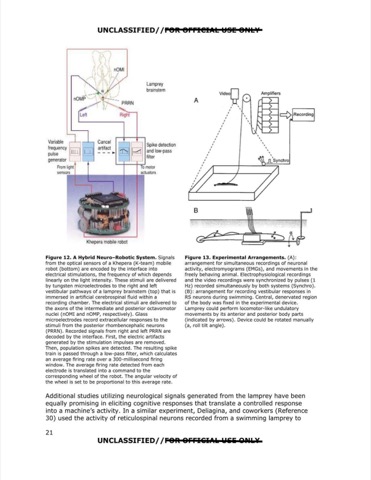
Image from page 27 of DOW-UAP-D130, as released by war.gov
Image from page 27 of the PDF. Open the scan to see the whole page.

Cite this page

U.S. Department of War. "AAWSAP DIRD, Technological Approaches to Controlling External Devices, March 2010" (DOW-UAP-D130). PURSUE Release 06, U.S. Department of War, September 18, 2026. https://www.war.gov/medialink/ufo/sept-18/release-06/assets/DOW-UAP-D130_AAWSAP-DIRD-Technological-Approaches-to-Controlling-External-Devices-March-23-2010.pdf. Declassified UAP, page 27, https://declassifieduap.org/r/dow-uap-d130-aawsap-dird-technological-approaches-to-controlling-external-devices-march-2010/p/27. Accessed November 28, 2026.

This address shows page 27 on its own; /r/dow-uap-d130-aawsap-dird-technological-approaches-to-controlling-external-devices-march-2010?page=27 opens the same page in the full reader. Both stay. How to cite.