Text of page 26
UNCLASSIFIED//P
USE ONLY
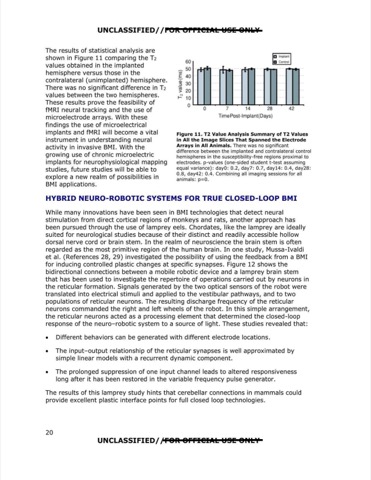
The results of statistical analysis are
shown in Figure 11 comparing the T2
values obtained in the implanted
hemisphere versus those in the
contralateral (unimplanted) hemisphere.
There was no significant difference in T2
values between the two hemispheres.
These results prove the feasibility of
MRI neural tracking and the use of
microelectrode arrays. With these
findings the use of microelectrical
implants and fMRI will become a vital
instrument in understanding neural
activity in invasive BMI. With the
growing use of chronic microelectric
implants for neurophysiological mapping
studies, future studies will be able to
explore a new realm of possibilities in
BMI applications.
60
1 Impkant
Control
Ta value (ms)
10
0
7
14
28
Time Post-Implant(Days)
42
Figure 11. T2 Value Analysis Summary of T2 Values
in All the Image Slices That Spanned the Electrode
Arrays in All Animals. There was no significant
difference between the implanted and contralateral control
hemispheres in the susceptibility-free regions proximal to
electrodes. p-values (one-sided student t-test assuming
equal variance): day0: 0.2, day7: 0.7, day14: 0.4, day28:
0.8, day42: 0.4. Combining all imaging sessions for all
animals: p=0.
HYBRID NEURO-ROBOTIC SYSTEMS FOR TRUE CLOSED-LOOP BMI
While many innovations have been seen in BMI technologies that detect neural
stimulation from direct cortical regions of monkeys and rats, another approach has
been pursued through the use of lamprey eels. Chordates, like the lamprey are ideally
suited for neurological studies because of their distinct and readily accessible hollow
dorsal nerve cord or brain stem. In the realm of neuroscience the brain stem is often
regarded as the most primitive region of the human brain. In one study, Mussa-Ivaldi
et al. (References 28, 29) investigated the possibility of using the feedback from a BMI
for inducing controlled plastic changes at specific synapses. Figure 12 shows the
bidirectional connections between a mobile robotic device and a lamprey brain stem
that has been used to investigate the repertoire of operations carried out by neurons in
the reticular formation. Signals generated by the two optical sensors of the robot were
translated into electrical stimuli and applied to the vestibular pathways, and to two
populations of reticular neurons. The resulting discharge frequency of the reticular
neurons commanded the right and left wheels of the robot. In this simple arrangement,
the reticular neurons acted as a processing element that determined the closed-loop
response of the neuro-robotic system to a source of light. These studies revealed that:
• Different behaviors can be generated with different electrode locations.
• The input-output relationship of the reticular synapses is well approximated by
simple linear models with a recurrent dynamic component.
•
The prolonged suppression of one input channel leads to altered responsiveness
long after it has been restored in the variable frequency pulse generator.
The results of this lamprey study hints that cerebellar connections in mammals could
provide excellent plastic interface points for full closed loop technologies.
20
UNCLASSIFIED//FOR OFFICIAL USE ONLY