Text of page 9
UNCLASSIFIED//FOR OFF
AL USE ONLY
3. Spin-Transfer-Torque
This section focuses on the spin-transfer-torque (STT) phenomenon, which refers to a
novel method to control and manipulate magnetic moments in nanostructures by spin
currents-one of the forefront and most exciting areas in magnetism research today.
3.1 STT BASICS
The previous section showed that the magnetic state of a ferromagnet can affect its
electrical transport properties; for instance, the relative orientation of the magnetic
moments in magnetic multilayers underlies the phenomenon of GMR (Reference 1, 2).
The inverse effect, in which a large electrical current density can perturb the magnetic
state of a multilayer, has also been predicted (Reference 3, 4). Here the current
transfers vector spin between the magnetic layers and induces precession and/or
reversal of the layer magnetizations. Altering the magnetic state with spin currents is
based on quantum mechanical exchange interaction and represents a novel method of
magnetization control on the nanometer length scale and the picosecond time scale.
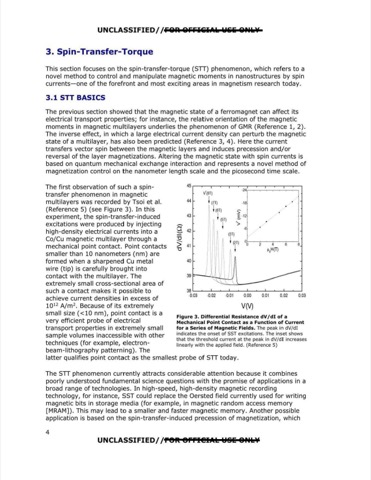
The first observation of such a spin-
45
transfer phenomenon in magnetic
V (BT)
-24
multilayers was recorded by Tsoi et al.
44
(Reference 5) (see Figure 3). In this
experiment, the spin-transfer-induced
43
(71)
+ (6T)
(5T)
-18
₴ 12-
excitations were produced by injecting
high-density electrical currents into a
Co/Cu magnetic multilayer through a
mechanical point contact. Point contacts
(0) 1P/AP
42
(3T)
+ (2)
41
2
HSH(T)
6
smaller than 10 nanometers (nm) are
formed when a sharpened Cu metal
40
wire (tip) is carefully brought into
contact with the multilayer. The
39
extremely small cross-sectional area of
such a contact makes it possible to
achieve current densities in excess of
38
-0.03
-0.02
-0.01
0.01
0.02
0.03
1012 A/m2. Because of its extremely
small size (<10 nm), point contact is a
very efficient probe of electrical
transport properties in extremely small
sample volumes inaccessible with other
techniques (for example, electron-
0.00
V(V)
Figure 3. Differential Resistance dV/dI of a
Mechanical Point Contact as a Function of Current
for a Series of Magnetic Fields. The peak in dV/dI
indicates the onset of SST excitations. The inset shows
that the threshold current at the peak in dV/dI increases
linearly with the applied field. (Reference 5)
beam-lithography patterning). The
latter qualifies point contact as the smallest probe of STT today.
The STT phenomenon currently attracts considerable attention because it combines
poorly understood fundamental science questions with the promise of applications in a
broad range of technologies. In high-speed, high-density magnetic recording
technology, for instance, SST could replace the Oersted field currently used for writing
magnetic bits in storage media (for example, in magnetic random access memory
[MRAM]). This may lead to a smaller and faster magnetic memory. Another possible
application is based on the spin-transfer-induced precession of magnetization, which
4
UNCLASSIFIED//FOR OFFICIAL USE ONLY