Text of page 10
UNCLASSIFIED//FOR OFF
AL USE ONLY
converts a direct current (dc) voltage input into an alternating current (ac) voltage
output. The frequency of such a precession can be tuned from a few gigahertz (GHz) to
> 100 GHz by changing the applied magnetic field and/or de current, effectively
resulting in a current-controlled oscillator for use in practical microwave circuits.
Since its prediction in 1996, the STT effect has been observed in a number of
experiments, including those with mechanical (Reference 5, 9, 40) and lithographic
point contacts (Reference 6, 41), manganite junctions (Reference 7), electrochemically
grown nanowires (Reference 8), lithographically defined nanopillars (Reference 42, 43),
tunnel junctions (Reference 44), and semiconductor structures (Reference 45). These
different methods all share one characteristic feature: they make it possible to attain
extremely high current densities (>1012 A/m? for metallic structures) needed to produce
sufficiently large spin-transfer torques (Reference 3, 4). This is achieved by forcing the
electrical current to flow through a very small constriction. The latter can be a
mechanical point contact, a lithographically defined point contact or nanopillar, or a
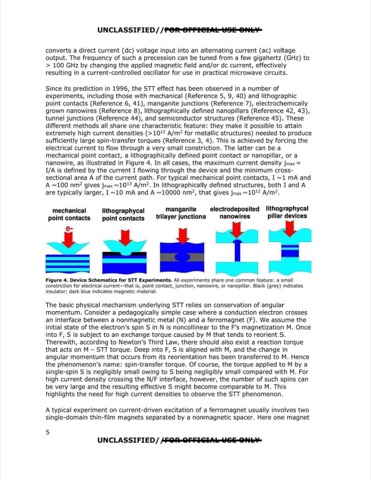
nanowire, as illustrated in Figure 4. In all cases, the maximum current density jmax =
I/A is defined by the current I flowing through the device and the minimum cross-
sectional area A of the current path. For typical mechanical point contacts, I ~ 1 mA and
A ~100 nm? gives jmax ~1013 A/m?. In lithographically defined structures, both I and A
are typically larger, I ~10 mA and A ~10000 nm?, that gives jmax ~ 1012 A/m?.
mechanical
point contacts
lithographycal
point contacts
manganite
trilayer junctions
electrodeposited
nanowires
lithographycal
pillar devices
Figure 4. Device Schematics for STT Experiments. All experiments share one common feature: a small
constriction for electrical current-that is, point contact, junction, nanowire, or nanopillar. Black (grey) indicates
insulator; dark blue indicates magnetic material.
The basic physical mechanism underlying STT relies on conservation of angular
momentum. Consider a pedagogically simple case where a conduction electron crosses
an interface between a nonmagnetic metal (N) and a ferromagnet (F). We assume the
initial state of the electron's spin S in N is noncollinear to the F's magnetization M. Once
into F, S is subject to an exchange torque caused by M that tends to reorient S.
Therewith, according to Newton's Third Law, there should also exist a reaction torque
that acts on M - STT torque. Deep into F, S is aligned with M, and the change in
angular momentum that occurs from its reorientation has been transferred to M. Hence
the phenomenon's name: spin-transfer torque. Of course, the torque applied to M by a
single-spin S is negligibly small owing to S being negligibly small compared with M. For
high current density crossing the N/ interface, however, the number of such spins can
be very large and the resulting effective S might become comparable to M. This
highlights the need for high current densities to observe the STT phenomenon.
A typical experiment on current-driven excitation of a ferromagnet usually involves two
single-domain thin-film magnets separated by a nonmagnetic spacer. Here one magnet
5
UNCLASSIFIED/ FOR
AL USE ONLY