Text of page 14
UNCLASSIFIED//FOR OFFH
AL USE ONLY
associated with high-frequency precession of magnetic moments. High-frequency
techniques must be employed to provide such capabilities, as discussed next.
The first experiment providing unequivocal evidence that a dc electrical current can
result in high-frequency (tens of GHz) precession of magnetic moments was reported
by Tsoi et al. in (Reference 9). Here an STT device-point contact-was placed in a
microwave cavity of a high-frequency, high-field electron spin resonance (ESR)
spectrometer. This arrangement allowed performing de transport experiments, such as
those described above, while the contact was irradiated with high-frequency
microwaves. When the frequency of external microwaves matched the precession
frequency excited by the de current, an additional (rectified) voltage was detected
across the contact. By detecting this voltage while varying the external frequency, field,
and applied current, Tsoi et al. (Reference 9) were able to map the frequency excited
by de current as a function of applied field and current. In a more recent experiment,
Rippard et al. (Reference 49) fed microwaves to a point contact via electrical leads and
reported observation of a similar de response.
Finally, the high-frequency dynamics of
the free-layer magnetization can be
measured directly by detecting high-
frequency oscillations in voltage across
a spin valve under de current. Here the
hard magnetic layer is fixed, while the
free layer exhibits a high-frequency
precession relative to the hard layer.
GMR results in a high-frequency
modulation of the spin-valve resistance,
which in turn leads to a high-frequency
component of the voltage across the
spin valve traversed by a dc current.
This voltage can be directly probed with
a high-frequency spectrum analyzer, as
was recently done by Kiselev et al.
(Reference 50) and by Rippard et al.
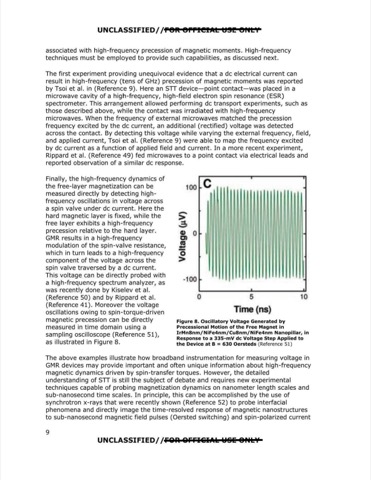
(Reference 41). Moreover the voltage
oscillations owing to spin-torque-driven
magnetic precession can be directly
measured in time domain using a
sampling oscilloscope (Reference 51),
as illustrated in Figure 8.
100
Voltage (uV)
0
-100 -
5
10
Time (ns)
Figure 8. Oscillatory Voltage Generated by
Precessional Motion of the Free Magnet in
Response 2335-m dc Voltage Step Applied to in
the Device at B = 630 Oersteds (Reference 51)
The above examples illustrate how broadband instrumentation for measuring voltage in
GMR devices may provide important and often unique information about high-frequency
magnetic dynamics driven by spin-transfer torques. However, the detailed
understanding of STT is still the subject of debate and requires new experimental
techniques capable of probing magnetization dynamics on nanometer length scales and
sub-nanosecond time scales. In principle, this can be accomplished by the use of
synchrotron x-rays that were recently shown (Reference 52) to probe interfacial
phenomena and directly image the time-resolved response of magnetic nanostructures
to sub-nanosecond magnetic field pulses (Oersted switching) and spin-polarized current
9
UNCLASSIFIED//FOR
AL USE ONLY