Text of page 37
UNCLASSIFIED/ /FeR e
AL UCE ONLY
1 In(b;)
b; - a;
1(45) ala)
1+ is
ell+j5)in(b,) - ell+j5)in(a)
bItis - al+is
(bi - a;) (1 + j5)
(b, - a,) (1+ j5)
(36)
opus the characteristic unct van if the a rel loy
b|+is - altis
Фу, (5) =
(37)
(bi - a,) (1+ j5)
3.3 STEP 7: FINDING THE
PROBABILITY DENSITY
FUNCTION OF N, BUT ONLY
NUMERICALLY NOT
ANALYTICALLY
Having found the characteristic functions
Ф,, (5) of the logs of the seven input random
variables Di, we can now immediately find the
characteristic function of the random variable Y =
In(N) defined by (5). In fact, by virtue of (4), of the
well-known Fourier transform property stating that
"the Fourier transform of a convolution is the product
of the
Fourier
transforms"
and
of (37), it
immediately follows that y (5) equals the product
of the seven y, (5):
Ф, (5) =
Ш Фу, (5) =
bitis - al+is
i=1
(bi - a;) (1+ j5)
(38)
The next step is to invert this Fourier transform in
order to get the probability density function of the
random variable Y = In(N). In other words, we must
compute the following inverse Fourier transform
- (e-15%, (5) d5
7-16 1(6) 45
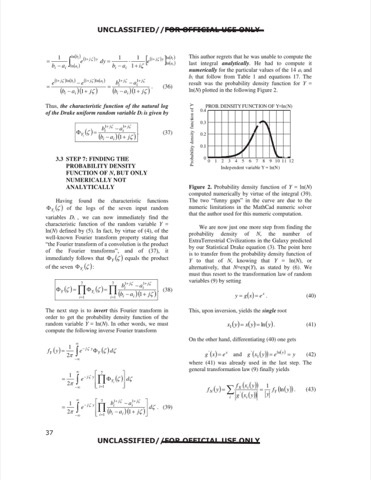
This author regrets that he was unable to compute the
last integral analytically. He had to compute it
numerically for the particular values of the 14 a; and
b; that follow from Table 1 and equations 17. The
result was the probability density function for Y =
In(N) plotted in the following Figure 2.
Probability density function of Y
PROB. DENSITY FUNCTION OF Y=In(N)
0.4
0.3
0.2
0.1
123 4 5 67 8 9 101112
Independent variable Y = In(N)
Figure 2. Probability density function of Y = In(N)
computed numerically by virtue of the integral (39).
The two "funny gaps" in the curve are due to the
numeric limitations in the MathCad numeric solver
that the author used for this numeric computation.
We are now just one more step from finding the
probability
density of N, the number
of
ExtraTerrestrial Civilizations in the Galaxy predicted
by our Statistical Drake equation (3). The point here
is to transfer from the probability density function of
Y to that of N, knowing that Y = In(N), or
alternatively, that N=exp(Y), as stated by (6). We
must thus resort to the transformation law of random
variables (9) by setting
y = 8(x) = e*.
(40)
This, upon inversion, yields the single root
x, (x) = xx) = In (y).
(41)
On the other hand, differentiating (40) one gets
8 (x)=e* and 8(x, (x)) = el*(v) = y
(42)
where (41) was already used in the last step. The
general transformation law (9) finally yields
78 (x;(v)
IS (In)).
(43)
b!+15 - a!+15
37
UNCLASSIFIED/ LEOR OFFICIAL USE ONLY