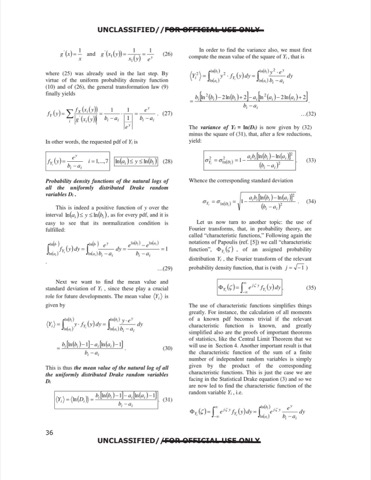
Text of page 36
UNCLASSIFIED/ /FeR OFFICIAL USE ONLY
8 (x) = 1
and
8 (x, (y)) =
x; (v)
(26)
where (25) was already used in the last step. By
virtue of the uniform probability density function
(10) and of (26), the general transformation law (9)
finally yields
7 8' (x, (y))
bi -a;
.. (27)
b; - a;
In other words, the requested pdf of Y, is
fr, (v) =
e"
bi - a;
i = 1,...,7
In(a) ≤ y ≤ In(b; )
(28)
Probability density functions of the natural logs of
all the uniformly distributed Drake random
variables Di.
This is indeed a positive function of y over the
interval In(a;) ≤ y ≤In(bi), as for every pdf, and it is
easy to
see that its normalization condition is
fulfilled:
n(a) Tr, (x) dy =
dy =
An(a) bi - a;
eIn(b) - eIn(a,)
— = 1
bi - a;
...(29)
Next we want to find the mean value and
standard deviation of Yi, since these play a crucial
role for future developments. The mean value (Y,) is
given by
dy
Jin(a) b; - a;
_bIn(b) - 11-ailin(a;) - 1]
bi - a;
(30)
This is thus the mean value of the natural log of all
the uniformly distributed Drake random variables
Di
(31)
bi - a;
36
In order to find the variance also, we must first
compute the mean value of the square of Yi, that is
(83)
eIn(b;)
- dy
In(a) b; - a;
_b In (.) - 21m (,) + 2) - a, lin (a) - 21m (a,) + 2)
bi - aj
...(32)
The variance of Y; = In(Di) is now given by (32)
minus the square of (31), that, after a few reductions,
yield:
0ỷ, = 0ỉ(D,) = 1-
a,b, [in (b;) - In (a,)F
(bi - a;)}
(33)
Whence the corresponding standard deviation
Ox, = 0 In(D,) =
a,b, [in (b;) - In (a;)l
• (34)
(bi -a;)}
Let us now turn to another topic: the use of
Fourier transforms, that, in probability theory, are
called "characteristic functions," Following again the
notations of Papoulis (ref. [5]) we call "characteristic
function", Ф, (5) , of
an
assigned probability
distribution Yi, the Fourier transform of the relevant
probability density function, that is (with j = V-1 )
Ф, (5)
eiss fr, (x) dy
(35)
The use of characteristic functions simplifies things
greatly. For instance, the calculation of all moments
of a known pdf becomes trivial if the relevant
characteristic
function is known, and greatly
simplified also are the proofs of important theorems
of statistics, like the Central Limit Theorem that we
will use in Section 4. Another important result is that
the characteristic function of the sum of a finite
number of independent random variables is simply
given
by the product of the corresponding
characteristic functions. This is just the case we are
facing in the Statistical Drake equation (3) and so we
are now led to find the characteristic function of the
random variable Yi, i.e.
8, 16) -5 05 5 0) i 21659
e'
- dy
b; - a;
UNCLASSIFIED//FOR
AL LISE ONLY