DOW-UAP-D127

AAWSAP DIRD, An Introduction to the Statistical Drake Equation, March 2010, page 18

One page of a U.S. government record released under PURSUE, shown on its own with its text. The record page has the whole document, its catalog details and the scan.

Page
18 of 55
Agency
Department of War
Released
Release 06, September 18, 2026

Text of page 18

UNCLASSIFIED/ / FOR OFFICIAL USE ONLY 8. Finding the Probability Distribution of the Et-Distance By Virtue of the Statistical Drake Equation Having solved the statistical Drake equation by finding the lognormal distribution, we are now in a position to solve the ET-DISTANCE problem by resorting to statistics again, rather than just to the purely deterministic Distance Law (5), as we did in Section 2. This is "scientifically more serious" than just the purely deterministic Distance Law (5) inasmuch as the new statistical Distance Law will yield a PROBABILITY DENSITY for the Distance, with the relevant mean value and standard deviation. In other words, the Distance Law (5) itself becomes a random variable whose probability distribution, mean value and standard deviation must be computed by "replacing" into (5) the fact that N is now known to follow the lognormal distribution. This is mathematically described in detail in Section 7 of Appendix A. The important new result is the PROBABILITY DENSITY FOR THE DISTANCE, the equation of which is * -н fer. Distane (r) = 3. V2 O 20° • e holding for r≥0. This is equation (114) of Appendix B. Starting from this equation, the MEAN VALUE OF THE random variable ET_DISTANCE is computed as (ET Distance) = Ce eg which is equation (119) of Appendix B, and finally the ET_DISTANCE STANDARD DEVIATION (9) (10) (11) which is equation (123) of Appendix B. Of course, all other descriptive statistical quantities, such as moments, cumulants etc. can be computed upon starting from the probability density (9), and the result is Table two hereafter, that is Table 3 of Appendix Finally, to complete this section, as well as this "introduction to the statistical Drake equation," the numerical values that equations (10) and (11) yield for the Input Table 1 are determined. They are, respectively: I mean _value = Ce 3 e 18 ≥ 2,670 light years (12) 18 UNCLASSIFIED/ /FOR OFFICIAL USE ONLY

Machine-read (OCR) from the scan by this archive; it can contain errors. The scan is the record.
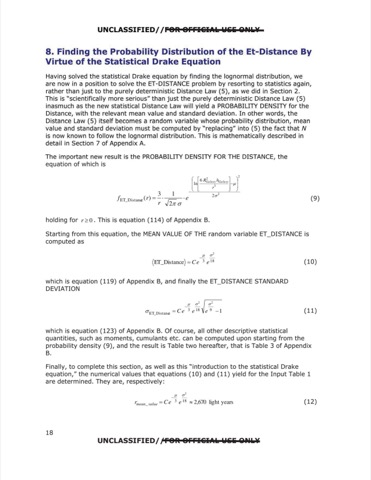
Image from page 18 of DOW-UAP-D127, as released by war.gov
Image from page 18 of the PDF. Open the scan to see the whole page.

Cite this page

U.S. Department of War. "AAWSAP DIRD, An Introduction to the Statistical Drake Equation, March 2010" (DOW-UAP-D127). PURSUE Release 06, U.S. Department of War, September 18, 2026. https://www.war.gov/medialink/ufo/sept-18/release-06/assets/DOW-UAP-D127_AAWSAP-DIRD-An-Introduction-to-the-Statistical-Drake-Equation-March-11-2010.pdf. Declassified UAP, page 18, https://declassifieduap.org/r/dow-uap-d127-aawsap-dird-an-introduction-to-the-statistical-drake-equation-march-2010/p/18. Accessed November 28, 2026.

This address shows page 18 on its own; /r/dow-uap-d127-aawsap-dird-an-introduction-to-the-statistical-drake-equation-march-2010?page=18 opens the same page in the full reader. Both stay. How to cite.