DOW-UAP-D127

AAWSAP DIRD, An Introduction to the Statistical Drake Equation, March 2010, page 17

One page of a U.S. government record released under PURSUE, shown on its own with its text. The record page has the whole document, its catalog details and the scan.

Page
17 of 55
Agency
Department of War
Released
Release 06, September 18, 2026

Text of page 17

UNCLASSIFIED/ /FeR eFFICIAL USE ONLY surprised to find out that it equals (N) =e* e 2 2 = 4589.559 ~ 4590 communicating civilizations now in the galaxy. This is the important number, and it is HIGHER than the 3500 provided by the classical Drake equation. Thus, in conclusion, THE STATISTICAL EXTENSION of the classical Drake equation INCREASES OUR HOPES to find an extraterrestrial civilization! PROBABILITY DENSITY FUNCTION OF N 6￾104 : 5.104 $ 4.104 3•104 2•104 1•104 0 0 1000 2000 3000 N = Number of ET Civilizations in Galaxy 4000 Figure 2. Comparing the Two Probability Density Functions of the Random Variable N Found (1) Without Resorting to the CLT at All (thick curve) and (2) Using the CLT and the Relevant Lognormal Approximation (thin curve). Even more so our hopes are increased when we go on to consider the standard deviation associated with the mean value 4590. In fact, the standard deviation is given by equation (97) of Appendix B. This yields oN =e* e 2 Ver -1 = 11195 and so the expected number of N may actually be even much higher than the 4590 provided by the mean value alone! The "upper limit of the one-sigma confidence interval" (as statisticians call it), i.e. the sum 4590+11195 = 15,785, yields a higher number still! (Note: the "lower limit of the one-sigma confidence interval is ZERO because the lognormal distribution is POSITIVE (or, more correctly, non-negative)). Finally, the reader should note that the thick curve depicted in Figure 2 is just the NUMERICAL solution of the statistical Drake equation for a FINITE number of 7 input factors. Figure 2 actually shows that this curve "is well interpolated" by the lognormal distribution (thin curve), i.e., by the neat analytical expression provided by the Central Limit Theorem for an INFINITE number of factors in the Drake equation. That is, in conclusion, Figure 2 visually shows that taking 7 factors or an infinity of factors "is almost the same thing" already for a value as small as 7. 17 UNCLASSIFIED/ FOR OFFICH AL USE ONLY

Machine-read (OCR) from the scan by this archive; it can contain errors. The scan is the record.
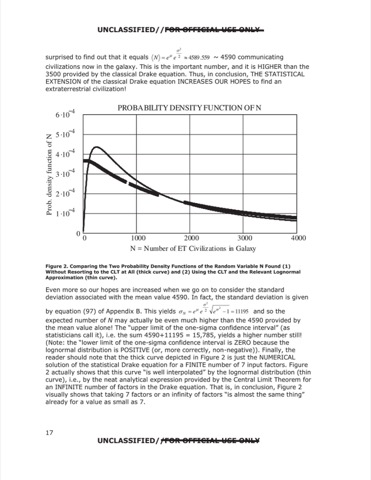
Image from page 17 of DOW-UAP-D127, as released by war.gov
Image from page 17 of the PDF. Open the scan to see the whole page.

Cite this page

U.S. Department of War. "AAWSAP DIRD, An Introduction to the Statistical Drake Equation, March 2010" (DOW-UAP-D127). PURSUE Release 06, U.S. Department of War, September 18, 2026. https://www.war.gov/medialink/ufo/sept-18/release-06/assets/DOW-UAP-D127_AAWSAP-DIRD-An-Introduction-to-the-Statistical-Drake-Equation-March-11-2010.pdf. Declassified UAP, page 17, https://declassifieduap.org/r/dow-uap-d127-aawsap-dird-an-introduction-to-the-statistical-drake-equation-march-2010/p/17. Accessed November 28, 2026.

This address shows page 17 on its own; /r/dow-uap-d127-aawsap-dird-an-introduction-to-the-statistical-drake-equation-march-2010?page=17 opens the same page in the full reader. Both stay. How to cite.