Text of page 35
UNCLASSIFIED// FOR OFFIeTAL USE ONLY
Calculations done by Muller, Rafelski, and Greiner (Reference 22) show that for
molecular states 35Br- 35Br, 53I- 79Au, and 92U- 92U, a twofold lowering of the distance of
and r. ke Ve respectively it a prescie or doorite to dye/mal ves tre 0. 35 k2,
the result of these calculations can be summarized by (JE in keV)
10g SE = 1.3 × 10⁻² Z - 1.4
(42)
replacing equation (40), where Z is here the sum of the nuclear charge for both
components of the molecule formed under the high pressure.
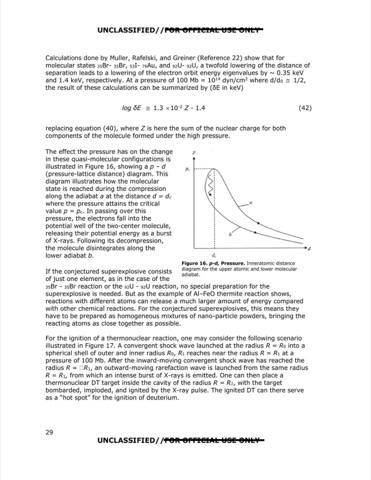
The effect the pressure has on the change
in these quasi-molecular configurations is
illustrated in Figure 16, showing a p - d
(pressure-lattice distance) diagram. This
diagram illustrates how the molecular
state is reached during the compression
along the adiabat a at the distance d = dc
where the pressure attains the critical
value p = pc. In passing over this
pressure, the electrons fall into the
potential well of the two-center molecule,
releasing their potential energy as a burst
of X-rays. Following its decompression,
the molecule disintegrates along the
lower adiabat b.
Pe
de
If the conjectured superexplosive consists
Figure 16. p-d, Pressure. Inneratomic distance
diagram for the upper atomic and lower molecular
adiabat.
of just one element, as in the case of the
35Br - 35Br reaction or the 92U - 92U reaction, no special preparation for the
superexplosive is needed. But as the example of Al-FeO thermite reaction shows,
reactions with different atoms can release a much larger amount of energy compared
with other chemical reactions. For the conjectured superexplosives, this means they
have to be prepared as homogeneous mixtures of nano-particle powders, bringing the
reacting atoms as close together as possible.
For the ignition of a thermonuclear reaction, one may consider the following scenario
illustrated in Figure 17. A convergent shock wave launched at the radius R = Ro into a
spherical shell of outer and inner radius Ro, Ri reaches near the radius R = Ri at a
pressure of 100 Mb. After the inward-moving convergent shock wave has reached the
radius R = [Ri, an outward-moving rarefaction wave is launched from the same radius
R = Ri, from which an intense burst of X-rays is emitted. One can then place a
thermonuclear DT target inside the cavity of the radius R = Ri, with the target
bombarded, imploded, and ignited by the X-ray pulse. The ignited DT can there serve
as a "hot spot" for the ignition of deuterium.
29
UNCLASSIFIED//FOR OFFICIAL USE ONLY