DOW-UAP-D126

AAWSAP DIRD, Advanced Nuclear Propulsion for Manned Deep Space Missions, March 2010, page 34

One page of a U.S. government record released under PURSUE, shown on its own with its text. The record page has the whole document, its catalog details and the scan.

Page
34 of 37
Agency
Department of War
Released
Release 06, September 18, 2026

Text of page 34

UNCLASSIFIED//FOR OFFICIAL USE ONLY • Bombardment of a solid target with beams or by hypervelocity impact, followed by a convergent shock wave. BOMBARDMENT OF A SOLID TARGET WITH AN INTENSE RELATIVISTIC ELECTRON OR ION BEAM This possibility was considered by Kidder (Reference 20), who computes a pressure of 50 Mb, if an iron plate is bombarded with a 1-M] - 10-MeV - 106 A relativistic electron beam, focused down to an area of 0.1 cm?. Accordingly, a 2-M] beam would produce 100 Mb. Instead of an intense relativistic electron beam, one may use an intense ion beam. It can be produced by the same high-voltage technique, replacing the electron beam diode by a magnetically insulated diode (Reference 21). Using intense ion beams has the additional benefit that the stopping of the ions in a target is determined by a Bragg curve, generating the maximum pressure inside the target, not on its surface. HYPERVELOCITY IMPACT A projectile with the density p ~ 20 g/cm3 accelerated to a velocity v = 30 km/s would, upon impact, produce a pressure of p ~ 100 Mb. The acceleration of the projectile to these velocities can be done by a magnetic traveling wave accelerator. BOMBARDMENT OF A SOLID TARGET WITH BEAMS OR BY HYPERVELOCITY IMPACT, FOLLOWED BY A CONVERGENT SHOCK WAVE If, upon impact of either a particle beam or a projectile, the pressure is less than 100 Mb (for example, only on the order of 10 Mb) but is acting over a larger area, a tenfold increase in the pressure over a smaller area is possible by launching a convergent shock wave from the larger area on the surface of the target onto a smaller area inside. According to Guderley, the rise in pressure in a convergent spherical shock wave goes as r -0.9, which means 100 Mb could be reached by a tenfold reduction in the radius of the convergent shock wave. While it is difficult to reach 30 km/s with a traveling magnetic wave accelerator, it is easy to reach a velocity of 10 km/s with a two-stage light gas gun. We assume an equation of state of the form p/ Po = (n/no)'. For a pressure of 100 Mb = 1014 dyn/cm2, we may set y= 3 and Po = 1011 dyn/cm2, Po being the Fermi pressure of a solid at the atomic number density n,, with n being the atomic number density at the elevated pressure p > Po. With d = n-1/3, , where d is the lattice constant, one has d/do = (p/po)=1/9 (41) Such a lowering of the inneratomic distance is sufficient for the formation of molecular states. 28 UNCLASSIFIED/ /FOR OFFICIAL USE ONLY

Machine-read (OCR) from the scan by this archive; it can contain errors. The scan is the record.
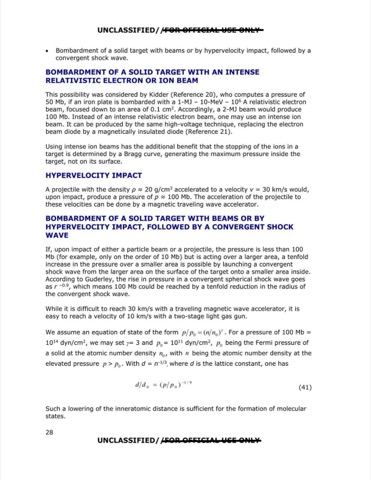
Image from page 34 of DOW-UAP-D126, as released by war.gov
Image from page 34 of the PDF. Open the scan to see the whole page.

Cite this page

U.S. Department of War. "AAWSAP DIRD, Advanced Nuclear Propulsion for Manned Deep Space Missions, March 2010" (DOW-UAP-D126). PURSUE Release 06, U.S. Department of War, September 18, 2026. https://www.war.gov/medialink/ufo/sept-18/release-06/assets/DOW-UAP-D126_AAWSAP-DIRD-Advanced-Nuclear-Propulsion-for-Manned-Deep-Space-Missions-March-11-2010.pdf. Declassified UAP, page 34, https://declassifieduap.org/r/dow-uap-d126-aawsap-dird-advanced-nuclear-propulsion-for-manned-deep-space-missions-march-2010/p/34. Accessed November 28, 2026.

This address shows page 34 on its own; /r/dow-uap-d126-aawsap-dird-advanced-nuclear-propulsion-for-manned-deep-space-missions-march-2010?page=34 opens the same page in the full reader. Both stay. How to cite.