DOW-UAP-D126

AAWSAP DIRD, Advanced Nuclear Propulsion for Manned Deep Space Missions, March 2010, page 24

One page of a U.S. government record released under PURSUE, shown on its own with its text. The record page has the whole document, its catalog details and the scan.

Page
24 of 37
Agency
Department of War
Released
Release 06, September 18, 2026

Text of page 24

UNCLASSIFIED//FOR OFFICIAL USE ONLY For E, = 5x10"erg, M, =10"g, and setting for v = 10 km/s = 106 cm/s the escape velocity from Earth, one finds that N ≥ 10. Assuming an efficiency of 10 percent, about 100 1-kiloton explosions would therefore be needed. Neutron Entrapment in an Autocatalytic Thermonuclear Detonation Wave - a Means to Increase the Specific Impulse and to Solve the Large Radiator Problem The principal reason why neutrons released by thermonuclear reactions pose such a serious problem is that they cannot be repelled from the spacecraft by a magnetic field. However, choosing a neutron-absorbing target as shown in Figure 3, one can reduce the flux of neutrons hitting the spacecraft. Besides inflicting material damage on the spacecraft, the neutrons release heat that must be removed by a very large radiator. The idea of the autocatalytic thermonuclear detonation wave (Reference 13) presents a solution, which if feasible would very much reduce the magnitude of this problem. For its implementation, it requires very large bremsstrahlung flux densities in the burn zone behind the thermonuclear detonation front. Such large bremsstrahlung flux densities will occur in deuterium detonation burn, at the highest temperature for all the thermonuclear reactions. In an autocatalytic thermonuclear detonation, explained in Figure 6, soft X-rays generated through the burn of the thermonuclear plasma behind the detonation front compress the still unburned thermonuclear fuel ahead of the front. The increase in the fuel density, both in the Teller-Ulam configuration and in the autocatalytic thermonuclear detonation wave, is of crucial importance, with the reaction rate proportional to the square of the density. Soft X-rays G DF. BZ. > Vo TE / Soft X-rays Figure 6. Autocatalytic Thermonuclear Detonation Using a Soft X-ray Precursor From the Burn Zone BZ to Precompress the Thermonuclear Fuel TF Ahead of the Detonation Front DF. The soft x-rays travel through the gap G between the tamp T and the liner L. 18 UNCLASSIFIED//FOR OFFrEIAL USE ONLY

Machine-read (OCR) from the scan by this archive; it can contain errors. The scan is the record.
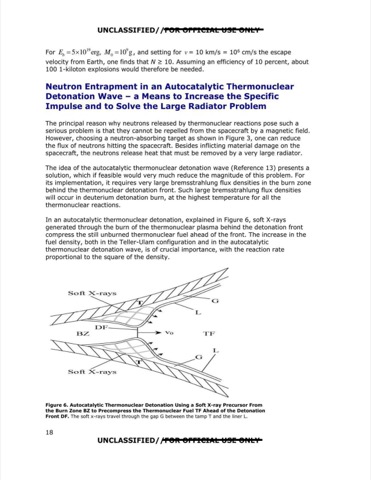
Image from page 24 of DOW-UAP-D126, as released by war.gov
Image from page 24 of the PDF. Open the scan to see the whole page.

Cite this page

U.S. Department of War. "AAWSAP DIRD, Advanced Nuclear Propulsion for Manned Deep Space Missions, March 2010" (DOW-UAP-D126). PURSUE Release 06, U.S. Department of War, September 18, 2026. https://www.war.gov/medialink/ufo/sept-18/release-06/assets/DOW-UAP-D126_AAWSAP-DIRD-Advanced-Nuclear-Propulsion-for-Manned-Deep-Space-Missions-March-11-2010.pdf. Declassified UAP, page 24, https://declassifieduap.org/r/dow-uap-d126-aawsap-dird-advanced-nuclear-propulsion-for-manned-deep-space-missions-march-2010/p/24. Accessed November 28, 2026.

This address shows page 24 on its own; /r/dow-uap-d126-aawsap-dird-advanced-nuclear-propulsion-for-manned-deep-space-missions-march-2010?page=24 opens the same page in the full reader. Both stay. How to cite.