DOW-UAP-D126

AAWSAP DIRD, Advanced Nuclear Propulsion for Manned Deep Space Missions, March 2010, page 23

One page of a U.S. government record released under PURSUE, shown on its own with its text. The record page has the whole document, its catalog details and the scan.

Page
23 of 37
Agency
Department of War
Released
Release 06, September 18, 2026

Text of page 23

UNCLASSIFIED/ FOR OFFICIAL USE ONLY of the cylindrical argon rod. If the shock is launched from a distance of ~1 m onto an argon rod with a radius equal to 10 cm, the temperature reaches 90,000 K, just right to excite the upper laser level of argon. Following its heating to 90,000 k, the argon cylinder radially expands and cools, with the upper laser level frozen into the argon. This is similar to a gas dynamic laser, where the upper laser level is frozen in the gas during its isentropic expansion in a Laval nozzle. To reduce depopulation of the upper laser level during the expansion by superradiance, one may dope to the argon with a saturable absorber, acting as an "antiknock" additive. In this way, megajoule laser pulses can be released within 10 nanoseconds. A laser pulse from a small Q-switched argon ion laser placed in the spacecraft can then launch a photon avalanche in the argon rod, igniting a DT microexplosion. 5p. HE DT D Q Figure 5. Argon Ion Laser Igniter, to Ignite a Staged DT →DD Fusion Explosion in a Mini-Teller-Ulam Configuration. A solid argon rod. HE cylindrical shell of high explosive, d detonators. Q Q-switched argon ion laser oscillator. Employing the Teller-Ulam configuration, by replacing the fission explosive with a DT microexplosion, one can then ignite a much larger DD explosion. As an alternative, one may generate a high current linear pinch discharge with a high- explosive-driven magnetic flux compression generator. If the current I is on the order of I = 107A, the laser can ignite a DT thermonuclear detonation wave propagating down the high current discharge channel, which in turn can ignite a much larger pure DD explosion. If the craft is launched from the Earth's surface, one has to take into account the mass of the air entrained in the fireball. The situation resembles a hot-gas-driven gun, albeit one of rather poor efficiency. There the velocity gained by the craft with N explosions, each setting off the energy E,, is given by v = /2NE,/M. (27) 17 UNCLASSIFIED/ /FOR OFFICIAL USE ONLY

Machine-read (OCR) from the scan by this archive; it can contain errors. The scan is the record.
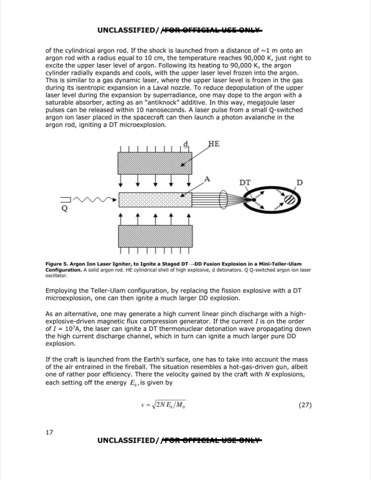
Image from page 23 of DOW-UAP-D126, as released by war.gov
Image from page 23 of the PDF. Open the scan to see the whole page.

Cite this page

U.S. Department of War. "AAWSAP DIRD, Advanced Nuclear Propulsion for Manned Deep Space Missions, March 2010" (DOW-UAP-D126). PURSUE Release 06, U.S. Department of War, September 18, 2026. https://www.war.gov/medialink/ufo/sept-18/release-06/assets/DOW-UAP-D126_AAWSAP-DIRD-Advanced-Nuclear-Propulsion-for-Manned-Deep-Space-Missions-March-11-2010.pdf. Declassified UAP, page 23, https://declassifieduap.org/r/dow-uap-d126-aawsap-dird-advanced-nuclear-propulsion-for-manned-deep-space-missions-march-2010/p/23. Accessed November 28, 2026.

This address shows page 23 on its own; /r/dow-uap-d126-aawsap-dird-advanced-nuclear-propulsion-for-manned-deep-space-missions-march-2010?page=23 opens the same page in the full reader. Both stay. How to cite.