Text of page 21
UNCLASSIFIED//FOR eFFIeTAL USE ONLY
Hydrogen H2 as a Neutron Moderator to Increase the Neutron Absorption Cross Section of Boron, With
the Neutrons Released From Deuterium Cylinder d.
As noted earlier, in comets there is a large amount of deuterium readily available for
mining. And we know comets also contain nitrogen and carbon. From this knowledge
we can assume that very likely other light elements, such as boron, exist in relatively
high concentrations in comets.
Although the waste heat radiator remains a problem, it favors large explosions, because
most of the waste heat accompanies the propellant into space. Droplet radiators, with
the droplets slowly evaporating, are unlikely to work. Placing the neutron-absorbing
radiators near the shock absorber, permitting them to get red-hot, and thermally
insulating the rest of the spacecraft from the radiators may solve the problem.
Delivery of a Gev Proton Beam Onto the Deuterium Fusion
Explosive
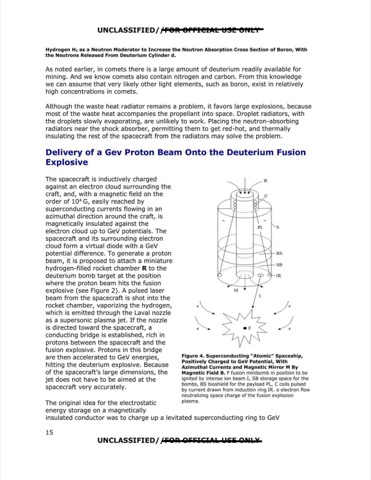
The spacecraft is inductively charged
against an electron cloud surrounding the
craft, and, with a magnetic field on the
order of 104G, easily reached by
superconducting currents flowing in an
azimuthal direction around the craft, is
magnetically insulated against the
electron cloud up to GeV potentials. The
spacecraft and its surrounding electron
cloud form a virtual diode with a GeV
potential difference. To generate a proton
beam, it is proposed to attach a miniature
hydrogen-filled rocket chamber R to the
deuterium bomb target at the position
where the proton beam hits the fusion
explosive (see Figure 2). A pulsed laser
beam from the spacecraft is shot into the
rocket chamber, vaporizing the hydrogen,
which is emitted through the Laval nozzle
as a supersonic plasma jet. If the nozzle
is directed toward the spacecraft, a
conducting bridge is established, rich in
protons between the spacecraft and the
fusion explosive. Protons in this bridge
are then accelerated to GeV energies,
hitting the deuterium explosive. Because
of the spacecraft's large dimensions, the
jet does not have to be aimed at the
spacecraft very accurately.
PL
BS
SB
- IR
Figure 4. Superconducting "Atomic" Spaceship,
Positively Charged to GeV Potential, With
Azimuthal Currents and Magnetic Mirror M By
Magnetic Field B. F fusion minibomb in position to be
ignited by intense ion beam I, SB storage space for the
bombs, BS bioshield for the payload PL, C coils pulsed
by current drawn from induction ring IR. e electron flow
neutralizing space charge of the fusion explosion
plasma.
The original idea for the electrostatic
energy storage on a magnetically
insulated conductor was to charge up a levitated superconducting ring to GeV
15
UNCLASSIFIED/ HFOR OFFICIAL USE ONLY