DOW-UAP-D126

AAWSAP DIRD, Advanced Nuclear Propulsion for Manned Deep Space Missions, March 2010, page 20

One page of a U.S. government record released under PURSUE, shown on its own with its text. The record page has the whole document, its catalog details and the scan.

Page
20 of 37
Agency
Department of War
Released
Release 06, September 18, 2026

Text of page 20

UNCLASSIFIED//TO AL USE ®NLY D www h Figure 2. Pure Deuterium Fusion Explosion Ignited With an Intense Ion Beam. D deuterium rod, h hohlraum, I ion beam, B magnetic field, R miniature target rocket chamber, He solid hydrogen, L laser beam to heat hydrogen in miniature rocket chamber. Because the condition for thermonuclear burn and detonation depends only on the critical current (Reference 15) and not on the radius of the deuterium cylinder, one may wish to make the diameter of the deuterium cylinder as small as possible, because as it was shown above, the specific impulse can become largest, with the electrons not taking away kinetic energy from the charged fusion products. Therefore, the yield of the deuterium fusion explosions can be made much smaller, eliminating the need for Orion- type shock absorbers, but the thrust there is also much smaller. For very-deep-space missions, that would not be a disadvantage. A problem in either case is that 38 percent of the energy is released as neutrons. In hitting the spacecraft, they lead to its heating, requiring a presumably large radiator. For a long and thin deuterium rod, this problem can likely be reduced by a boron diaphragm on the deuterium rod, as shown in Figure 3, because boron is a good neutron absorber. It can be enhanced by a hydrogen moderator, because the absorption cross section for neutrons is greatly increased with a reduced neutron kinetic energy. Both the boron and the hydrogen there simply become part of the propellant, reducing the specific impulse but increasing the thrust. b H2 - d SC Figure 3. Screening of the Spacecraft, SC, Against the Neutrons, n, By a Boron Diaphragm, b, With Solid 14 UNCLASSIFIED/ /FOR OFFICIAL USE ONLY

Machine-read (OCR) from the scan by this archive; it can contain errors. The scan is the record.
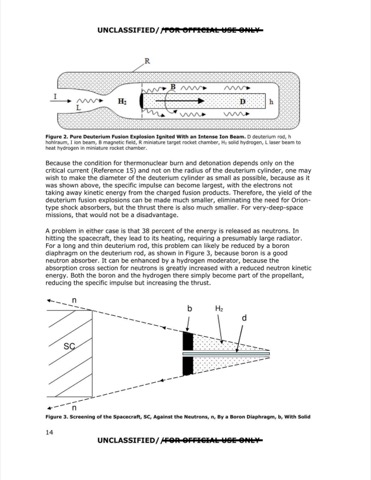
Image from page 20 of DOW-UAP-D126, as released by war.gov
Image from page 20 of the PDF. Open the scan to see the whole page.

Cite this page

U.S. Department of War. "AAWSAP DIRD, Advanced Nuclear Propulsion for Manned Deep Space Missions, March 2010" (DOW-UAP-D126). PURSUE Release 06, U.S. Department of War, September 18, 2026. https://www.war.gov/medialink/ufo/sept-18/release-06/assets/DOW-UAP-D126_AAWSAP-DIRD-Advanced-Nuclear-Propulsion-for-Manned-Deep-Space-Missions-March-11-2010.pdf. Declassified UAP, page 20, https://declassifieduap.org/r/dow-uap-d126-aawsap-dird-advanced-nuclear-propulsion-for-manned-deep-space-missions-march-2010/p/20. Accessed November 28, 2026.

This address shows page 20 on its own; /r/dow-uap-d126-aawsap-dird-advanced-nuclear-propulsion-for-manned-deep-space-missions-march-2010?page=20 opens the same page in the full reader. Both stay. How to cite.