Text of page 63
UNCLASSIFIED/ /FeR eFFIelAL USE ONLY
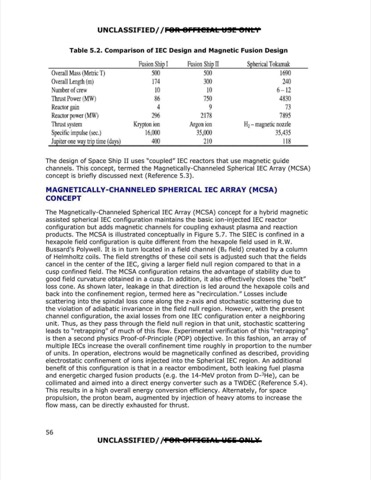
Table 5.2. Comparison of IEC Design and Magnetic Fusion Design
Fusion Ship I
Fusion Ship II
Overall Mass (Metric T)
Overall Length (m)
Number of crew
Thrust Power (MW)
Reactor gain
Reactor power (MW)
Thrust system
Specific impulse (sec.)
Jupiter one way trip time (days)
500
500
174
300
10
86
4
296
Krypton ion
16,000
400
750
9
2178
Argon ion
35,000
210
Spherical Tokamak
1690
240
6-12
4830
73
7895
H2 - magnetic nozzle
35,435
118
The des. of conce st, termed Magnetical hans ted Surerical it Aguad (MCSA)
concept is briefly discussed next (Reference 5.3).
MAGNETICALLY-CHANNELED SPHERICAL IEC ARRAY (MCSA)
CONCEPT
The Magnetically-Channeled Spherical IEC Array (MCSA) concept for a hybrid magnetic
assisted spherical IEC configuration maintains the basic ion-injected IEC reactor
configuration but adds magnetic channels for coupling exhaust plasma and reaction
products. The MCSA is illustrated conceptually in Figure 5.7. The SIEC is confined in a
hexapole field configuration is quite different from the hexapole field used in R.W.
Bussard's Polywell. It is in turn located in a field channel (Bz field) created by a column
of Helmholtz coils. The field strengths of these coil sets is adjusted such that the fields
cancel in the center of the IEC, giving a larger field null region compared to that in a
cusp confined field. The MCSA configuration retains the advantage of stability due to
good field curvature obtained in a cusp. In addition, it also effectively closes the "belt"
loss cone. As shown later, leakage in that direction is led around the hexapole coils and
back into the confinement region, termed here as "recirculation." Losses include
scattering into the spindal loss cone along the z-axis and stochastic scattering due to
the violation of adiabatic invariance in the field null region. However, with the present
channel configuration, the axial losses from one IEC configuration enter a neighboring
unit. Thus, as they pass through the field null region in that unit, stochastic scattering
leads to "retrapping" of much of this flow. Experimental verification of this "retrapping"
is then a second physics Proof-of-Principle (POP) objective. In this fashion, an array of
multiple IECs increase the overall confinement time roughly in proportion to the number
of units. In operation, electrons would be magnetically confined as described, providing
electrostatic confinement of ions injected into the Spherical IEC region. An additional
benefit of this configuration is that in a reactor embodiment, both leaking fuel plasma
and energetic charged fusion products (e.g. the 14-MeV proton from D-3He), can be
collimated and aimed into a direct energy converter such as a TWDEC (Reference 5.4).
This results in a high overall energy conversion efficiency. Alternately, for space
propulsion, the proton beam, augmented by injection of heavy atoms to increase the
flow mass, can be directly exhausted for thrust.
56
UNCLASSIFIED//FOR OFFICIAL USE ONLY