Text of page 62
UNCLASSIFIED//FOR OF
AL USE ONLY
valuable fuels, especially the 3He. The ion thrusters run on Argon propellant at a
specific impulse of 35,000 sec and an efficiency of 90 percent. The thrust is produced
4370 Newtons, probably an initial acceleration of .0087 m/s. A typical trip time for an
out-and-back mission to Jupiter is 210 days out and 153 days to return. This is
comparable to or faster than that predicted in prior fusion studies.
Top View
300 m
Back view
DEC
175 m
Тол
Trusters
Crew Arca
Argon
TEC Reactor (10 total)
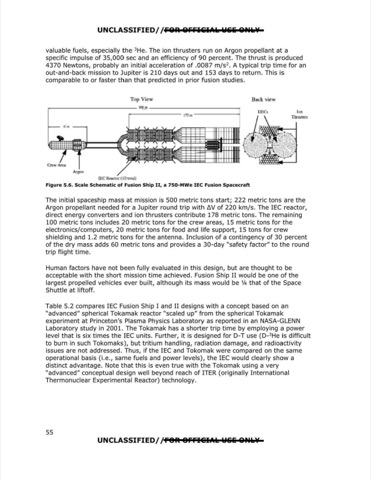
Figure 5.6. Scale Schematic of Fusion Ship II, a 750-MWe IEC Fusion Spacecraft
The initial spaceship mass at mission is 500 metric tons start; 222 metric tons are the
Argon propellant needed for a Jupiter round trip with AV of 220 km/s. The IC reactor,
direct energy converters and ion thrusters contribute 178 metric tons. The remaining
100 metric tons includes 20 metric tons for the crew areas, 15 metric tons for the
electronics/computers, 20 metric tons for food and life support, 15 tons for crew
shielding and 1.2 metric tons for the antenna. Inclusion of a contingency of 30 percent
of the dry mass adds 60 metric tons and provides a 30-day "safety factor" to the round
trip flight time.
Human factors have not been fully evaluated in this design, but are thought to be
acceptable with the short mission time achieved. Fusion Ship II would be one of the
largest propelled vehicles ever built, although its mass would be ¼ that of the Space
Shuttle at liftoff.
Table 5.2 compares IEC Fusion Ship I and II designs with a concept based on an
"advanced" spherical Tokamak reactor "scaled up" from the spherical Tokamak
experiment at Princeton's Plasma Physics Laboratory as reported in an NASA-GLENN
Laboratory study in 2001. The Tokamak has a shorter trip time by employing a power
level that is six times the IEC units. Further, it is designed for D-T use (D-3He is difficult
to burn in such Tokomaks), but tritium handling, radiation damage, and radioactivity
issues are not addressed. Thus, if the IEC and Tokomak were compared on the same
operational basis (i.e., same fuels and power levels), the IEC would clearly show a
distinct advantage. Note that this is even true with the Tokomak using a very
"advanced" conceptual design well beyond reach of ITER (originally International
Thermonuclear Experimental Reactor) technology.
55
UNCLASSIFIED/ /FOR OFFICIAL USE ONLY