Text of page 47
UNCLASSIFIED/ /FOR 9F
AL USE ONLY
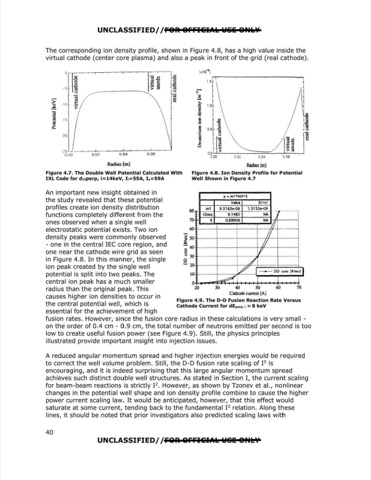
The corresponding ion density profile, shown in Figure 4.8, has a high value inside the
virtual cathode (center core plasma) and also a peak in front of the grid (real cathode).
virtual cathode
virtual
anode
real cathode
Potential [keV]
20
Deuterium ion density [m 3]
1.0 -
0.5 -
8.00
0.02
0.04
0.06
virtual cathode
virtual
anode
0.02
0.04
0.06
Radius [m]
Radius (m]
Figure 4.7. The Double Well Potential Calculated With
Figure 4.8. Ion Density Profile for Potential
IXL Code for disperp, i=14keV, I =55A, Ie=59A
Well Shown in Figure 4.7
real cathode
An important new insight obtained in
the study revealed that these potential
profiles create ion density distribution
functions completely different from the
m1
Chisa
y - m1*m045
Value
9.51 63e-08
9.1482
0.99906
Error
1.5155c-09
NA
NA
ones observed when a single well
electrostatic potential exists. Two ion
density peaks were commonly observed
- one in the central IEC core region, and
one near the cathode wire grid as seen
in Figure 4.8. In this manner, the single
ion peak created by the single well
potential is split into two peaks. The
central ion peak has a much smaller
radius than the original peak. This
60
50
40
core
8
• 58%
20
• - DD core [#/see)
30
60
causes higher ion densities to occur in
the central potential well, which is
40
50
Cathode current [A]
Figure 4.9. The D-D Fusion Reaction Rate Versus
Cathode Current for dEperp, 1 = 8 keV
70
essential for the achievement of high
fusion rates. However, since the fusion core radius in these calculations is very small -
on the order of 0.4 cm - 0.9 cm, the total number of neutrons emitted per second is too
low to create useful fusion power (see Figure 4.9). Still, the physics principles
illustrated provide important insight into injection issues.
A reduced angular momentum spread and higher injection energies would be required
to correct the well volume problem. Still, the D-D fusion rate scaling of I5 is
encouraging, and it is indeed surprising that this large angular momentum spread
achieves such distinct double well structures. As stated in Section I, the current scaling
for beam-beam reactions is strictly I. However, as shown by Tzonev et al., nonlinear
changes in the potential well shape and ion density profile combine to cause the higher
power current scaling law. It would be anticipated, however, that this effect would
saturate at some current, tending back to the fundamental I2 relation. Along these
lines, it should be noted that prior investigators also predicted scaling laws with
40
UNCLASSIFIED/ /FO
AL USE ONLY