Text of page 46
UNCLASSIFIED//TOR OF
AL USE ONLY
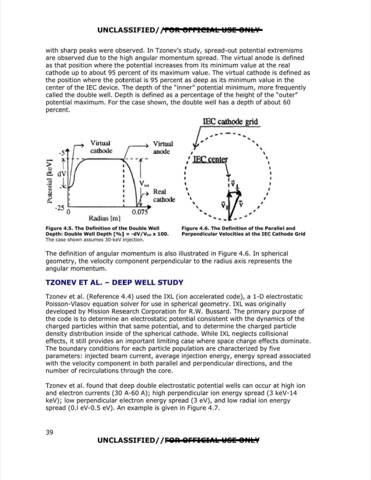
with sharp peaks were observed. In Tzonev's study, spread-out potential extremisms
are observed due to the high angular momentum spread. The virtual anode is defined
as that position where the potential increases from its minimum value at the real
cathode up to about 95 percent of its maximum value. The virtual cathode is defined as
the position where the potential is 95 percent as deep as its minimum value in the
center of the IEC device. The depth of the "inner" potential minimum, more frequently
called the double well. Depth is defined as a percentage of the height of the "outer"
potential maximum. For the case shown, the double well has a depth of about 60
percent.
TEC cathode grid
Virtual
cathode
Virtual
anode
/ JEC center
Vlot
Real
cathode
0.075
Radius [m]
Figure 4.5. The Definition of the Double Well
Depth: Double Well Depth [%] = -V/Vtot X 100.
The case shown assumes 30-keV injection.
Figure 4.6. The Definition of the Parallel and
Perpendicular Velocities at the IEC Cathode Grid
The definition of angular momentum is also illustrated in Figure 4.6. In spherical
geometry, the velocity component perpendicular to the radius axis represents the
angular momentum.
TZONEV ET AL. - DEEP WELL STUDY
Tzonev et al. (Reference 4.4) used the IXL (ion accelerated code), a 1-D electrostatic
Poisson-Vlasov equation solver for use in spherical geometry. IXL was originally
developed by Mission Research Corporation for R.W. Bussard. The primary purpose of
the code is to determine an electrostatic potential consistent with the dynamics of the
charged particles within that same potential, and to determine the charged particle
density distribution inside of the spherical cathode. While IXL neglects collisional
effects, it still provides an important limiting case where space charge effects dominate.
The boundary conditions for each particle population are characterized by five
parameters: injected beam current, average injection energy, energy spread associated
with the velocity component in both parallel and perpendicular directions, and the
number of recirculations through the core.
Tzone et al. found that deep double electrostatic potential wells can occur at high ion
and electron currents (30 A-60 A); high perpendicular ion energy spread (3 keV-14
keV); low perpendicular electron energy spread (3 eV), and low radial ion energy
spread (0.1 eV-0.5 eV). An example is given in Figure 4.7.
39
UNCLASSIFIED// FOR OFFICIAL USE ONLY