DOW-UAP-D125

AAWSAP DIRD, Inertial Electrostatic Confinement Fusion, March 2010, page 42

One page of a U.S. government record released under PURSUE, shown on its own with its text. The record page has the whole document, its catalog details and the scan.

Page
42 of 72
Agency
Department of War
Released
Release 06, September 18, 2026

Text of page 42

UNCLASSIFIED//FOR OFFICIAL USE ONLY events take place. Accordingly, he predicted that the Q-value (defined the ratio of fusion power out to ion input power) of an IEC device operating with a 50/50 percent deuterium-tritium (D-T) mixture would be ~0.21 for a 50-kV square well. This conclusion would rule out the possibility of a fusion reactor, but would leave open the development of driven neutron sources. However, this analysis contains several questionable assumptions. For example, a tightly focused monoenergetic ion beam is in fact a pessimistic scenario, because different co-moving ion species (such as D and T with the same energy) result in a finite speed difference, thus fostering ion-ion collisions and the degradation of the ion distribution function. It would be more realistic to consider that, in a square well, friction between species would homogenize the speed within the ion beam after some time, making the speed difference infinitesimal. This line of argument was pursued earlier by Barnes et al., (Reference 4.3) who found Q ~ 1.3 for the same system. ION INJECTION PORT Ion extraction grid Ion divertor Vext "D Electron divertor E-Emax Pseudo-spherical well for ion confinement E=Eo Anode wall (ground) Figure 4.2. Detail of the Anode and the Ion Injection Port in PFX-I (not to scale), Ion and electron divertors are indicated, as well as the Eo and Emax equipotential lines that define the ion confinement region. The Eo contour line determines the region of absolute ion confinement. In Chacon's work, a bounce-averaged Fokker-Planck (BAFP) model was employed to obtain steady-state solutions for the ion distribution function and to calculate associated fusion energy gains (Q-values) in a variety of operating conditions. These is done in terms of source and sink strengths, ion injection energies, well depths, and electrostatic potential shapes. Thus, the limiting assumptions by Nevins- namely that ions are confined in a square potential well, and that their distribution is tightly focused and monoenergetic, are relaxed. When these restrictive assumptions are removed, it is found that large energy gains (Qs of hundreds) for beam-like solutions in square wells 35 UNCLASSIFIED//FOR OFFICIAL USE ONLY

Machine-read (OCR) from the scan by this archive; it can contain errors. The scan is the record.
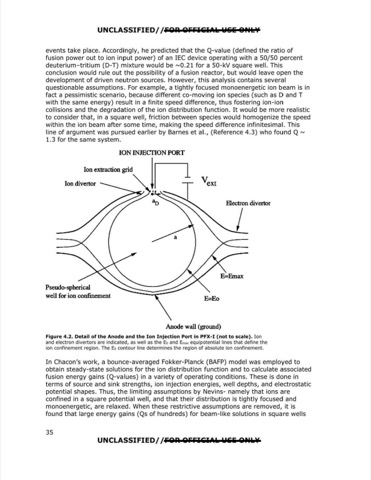
Image from page 42 of DOW-UAP-D125, as released by war.gov
Image from page 42 of the PDF. Open the scan to see the whole page.

Cite this page

U.S. Department of War. "AAWSAP DIRD, Inertial Electrostatic Confinement Fusion, March 2010" (DOW-UAP-D125). PURSUE Release 06, U.S. Department of War, September 18, 2026. https://www.war.gov/medialink/ufo/sept-18/release-06/assets/DOW-UAP-D125_AAWSA-DIRD-Inertial-Electrostatic-Confinement-Fusion-March-10-2010.pdf. Declassified UAP, page 42, https://declassifieduap.org/r/dow-uap-d125-aawsap-dird-inertial-electrostatic-confinement-fusion-march-2010/p/42. Accessed November 28, 2026.

This address shows page 42 on its own; /r/dow-uap-d125-aawsap-dird-inertial-electrostatic-confinement-fusion-march-2010?page=42 opens the same page in the full reader. Both stay. How to cite.