DOW-UAP-D125

AAWSAP DIRD, Inertial Electrostatic Confinement Fusion, March 2010, page 26

One page of a U.S. government record released under PURSUE, shown on its own with its text. The record page has the whole document, its catalog details and the scan.

Page
26 of 72
Agency
Department of War
Released
Release 06, September 18, 2026

Text of page 26

UNCLASSIFIED//FOR OFFIC ALICE ONLY found that there is an optimum voltage in terms of a maximum IEC cathode current. Ions supplied by the magnetron ion source are essential to maintain the hybrid (glow and magnetron) discharge under low gas pressure conditions. The reason for this voltage limit is not clear. Unfortunately this effect limits the cathode voltage despite the need for high voltage for neutron production near the peak energy of the fusion cross section. Thus this issue deserves more study to optimize use of a hybrid magnetron source IEC operation. Still the design worked reasonably well for the initial mine detection experiments. Unfortunately, the project was terminated prematurely due to financial constraints, so information on optimization possibility remains incomplete. The design of the ion source also depends on the ion species being injected. Sources described thus far have focused on deuterium or, in some cases on tritium. However, workers at the University of Wisconsin (U. Wisc.) have had a great interest in 3He reactions (both D-3He and 3He-3He), so have developed a gun specialized to 3He ion production (Reference 2.8). To maximize the ion current, a Helicon source was selected since Helicons are well known for production of very high density plasmas from which high ion currents can be extracted. This source is illustrated in Figure 2.6 and discussed in Reference 2.8. They state that this source has produced steady-state ion currents of 10 mA into IEC systems with background gas pressures as low as 200 utorr. Figure 2.6. 3He Ion Source for Use in 3He-3He Fusion Rate Studies at the U of Wisconsin These developments are aimed at observation of the 3He-3He reaction in an IEC device. Scoping calculations of beam-background fusion rates predict that a 3He-3He reaction product spectrum should be distinctly observable in an IEC operating below 200 kV. 19 UNCLASSIFIED/ /F© H USE ONLY

Machine-read (OCR) from the scan by this archive; it can contain errors. The scan is the record.
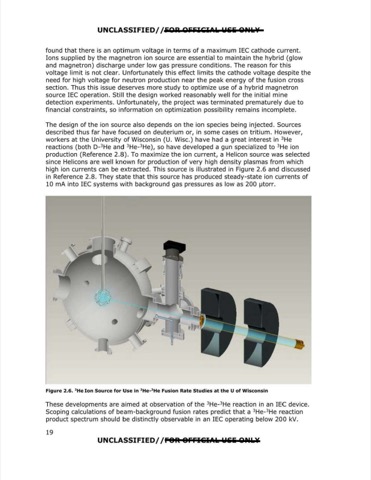
Image from page 26 of DOW-UAP-D125, as released by war.gov
Image from page 26 of the PDF. Open the scan to see the whole page.

Cite this page

U.S. Department of War. "AAWSAP DIRD, Inertial Electrostatic Confinement Fusion, March 2010" (DOW-UAP-D125). PURSUE Release 06, U.S. Department of War, September 18, 2026. https://www.war.gov/medialink/ufo/sept-18/release-06/assets/DOW-UAP-D125_AAWSA-DIRD-Inertial-Electrostatic-Confinement-Fusion-March-10-2010.pdf. Declassified UAP, page 26, https://declassifieduap.org/r/dow-uap-d125-aawsap-dird-inertial-electrostatic-confinement-fusion-march-2010/p/26. Accessed November 28, 2026.

This address shows page 26 on its own; /r/dow-uap-d125-aawsap-dird-inertial-electrostatic-confinement-fusion-march-2010?page=26 opens the same page in the full reader. Both stay. How to cite.