DOW-UAP-D124

AAWSAP DIRD, Space Access: Where We’ve Been and Where We Could Go, March 2010, page 46

One page of a U.S. government record released under PURSUE, shown on its own with its text. The record page has the whole document, its catalog details and the scan.

Page
46 of 56
Agency
Department of War
Released
Release 06, September 18, 2026

Text of page 46

UNCLASSIFIED/ /T LEO-Lunar Routes ?? Planets Planetary Exploration Space Based Warning Navigation Weather GEO Satellites deceased MIR Geostationary Orbit Communications Warning Space Based Tracking Space Station N-RLV Communications Observation Spaceways Entering the 21st century From Dr. William Gaubatz Figure 43. Where We Are Today Although not addressed in the frontline technical or popular press, a critical element in reaching space beyond Earth is the establishment of a space infrastructure around Earth and the moon. The concept of this infrastructure as a train marshalling and switching yard is appropriate. The rail control center serves as a center of operations for switching, long-haul train assembly, transfer of goods, and refueling and repair of space assets. Likewise, the orbital stations serve as centers for switching payloads between carriers and the required orbit, long-haul space exploration vehicle assembly, transfer of goods to human habitats and manufacturing facilities, and return, refueling, and repair coordination. This is no trivial activity and will take a commitment as dedicated as the Apollo program to achieve. Without an infrastructure, we are doomed to expendable vehicles at low launch rates for specific, one-time missions with no semblance of an infrastructure. Neither the United Kingdom nor the United States had any long-distance, two-way commerce until the railroads were established. After that, cities and commerce centers were created, enabling two-way commerce. The space business has it backwards: There is no commerce until the infrastructure is in place, not vice versa. How are we ever going to get here? How are we going to create a LEO infrastructure that can support the LEO, geostationary orbit, and lunar assets depicted in Figure 44? Is it a technology issue? Hardly! We have known for 50 years how to create it. Werner von Braun had Walt Disney create a clear visual image of what is required. But nobody listened, as we were too busy creating new things and throwing away the old things, destroying any development continuity. A good example is the destruction of the capability to make Saturn I and Saturn V launchers. 39 UNCLASSIFIED/ FOR OFFI AL USE ONLY

Machine-read (OCR) from the scan by this archive; it can contain errors. The scan is the record.
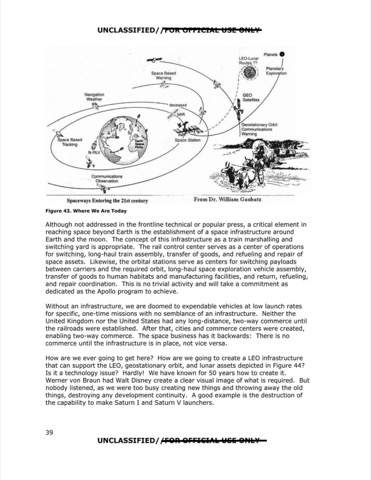
Image from page 46 of DOW-UAP-D124, as released by war.gov
Image from page 46 of the PDF. Open the scan to see the whole page.

Cite this page

U.S. Department of War. "AAWSAP DIRD, Space Access: Where We’ve Been and Where We Could Go, March 2010" (DOW-UAP-D124). PURSUE Release 06, U.S. Department of War, September 18, 2026. https://www.war.gov/medialink/ufo/sept-18/release-06/assets/DOW-UAP-D124_AAWSAP-DIRD-Space%20Access-Where-Weve-Been-and-Where-We-Could-Go-March-8-2010.pdf. Declassified UAP, page 46, https://declassifieduap.org/r/dow-uap-d124-aawsap-dird-space-access-where-weve-been-and-where-we-could-go-march-2010/p/46. Accessed November 28, 2026.

This address shows page 46 on its own; /r/dow-uap-d124-aawsap-dird-space-access-where-weve-been-and-where-we-could-go-march-2010?page=46 opens the same page in the full reader. Both stay. How to cite.