Text of page 32
UNCLASSIFIED/ /FOR OFFe
AL USE ONLY
Rocket Propulsion
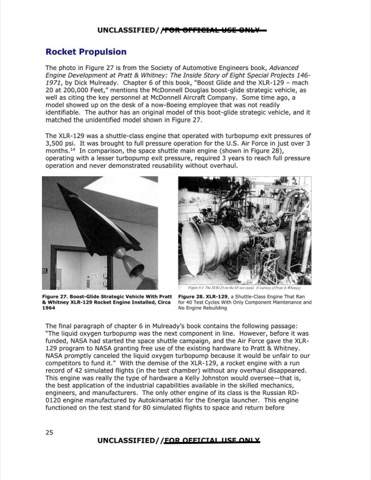
The photo in Figure 27 is from the Society of Automotive Engineers book, Advanced
Engine Development at Pratt & Whitney: The Inside Story of Eight Special Projects 146-
1971, by Dick Mulready. Chapter 6 of this book, "Boost Glide and the XLR-129 - mach
20 at 200,000 Feet," mentions the McDonnell Douglas boost-glide strategic vehicle, as
well as citing the key personnel at McDonnell Aircraft Company. Some time ago, a
model showed up on the desk of a now-Boeing employee that was not readily
identifiable. The author has an original model of this boot-glide strategic vehicle, and it
matched the unidentified model shown in Figure 27.
The XLR-129 was a shuttle-class engine that operated with turbopump exit pressures of
3,500 psi. It was brought to full pressure operation for the U.S. Air Force in just over 3
months.14 In comparison, the space shuttle main engine (shown in Figure 28),
operating with a lesser turbopump exit pressure, required 3 years to reach full pressure
operation and never demonstrated reusability without overhaul.
Figure 27. Boost-Glide Strategic Vehicle With Pratt
& Whitney XLR-129 Rocket Engine Installed, Circa
1964
Figure 8.4 The XI.RI 29 on the E8 test stand. (Courtesy of Pratt & Whimey)
Figure 28. XLR-129, a Shuttle-Class Engine That Ran
for 40 Test Cycles With Only Component Maintenance and
No Engine Rebuilding
The final paragraph of chapter 6 in Mulready's book contains the following passage:
"The liquid oxygen turbopump was the next component in line. However, before it was
funded, NASA had started the space shuttle campaign, and the Air Force gave the XLR-
129 program to NASA granting free use of the existing hardware to Pratt & Whitney.
NASA promptly canceled the liquid oxygen turbopump because it would be unfair to our
competitors to fund it." With the demise of the XLR-129, a rocket engine with a run
record of 42 simulated flights (in the test chamber) without any overhaul disappeared.
This engine was really the type of hardware a Kelly Johnston would oversee-that is,
the best application of the industrial capabilities available in the skilled mechanics,
engineers, and manufacturers. The only other engine of its class is the Russian RD-
0120 engine manufactured by Autokinamatiki for the Energia launcher. This engine
functioned on the test stand for 80 simulated flights to space and return before
25
UNCLASSIFIED//EOR OFFICIAL USE ONLY