DOW-UAP-D123

AAWSAP DIRD, Positron Aerospace Propulsion, March 2010, page 18

One page of a U.S. government record released under PURSUE, shown on its own with its text. The record page has the whole document, its catalog details and the scan.

Page
18 of 35
Agency
Department of War
Released
Release 06, September 18, 2026

Text of page 18

UNCLASSIFIED/TTOR OFFICIAL USE ONLY the order of 30 minutes, indicating that a spacecraft employing three 72-kN solid-core engines would require 6-9 mg of positrons per mission. Solid-core fission and positron systems are compared in Table 4. Table 4. Comparison of Space Propulsion and Power Systems - Solid Core Technology Performance Operation Materials Payload Integration Fission-Based • NERVA/Rover demonstrated • Never flight tested • Isp = 950 sec • Thrust = 72 - 123 kN • Power = 367- 5320 MW (matched to thrust) • Lifetime = 2 hours total operation • Design dictated by neutronics, fuel burn up and fission poisoning • High neutron & gamma radiation during operation • Requires active, accurate and massive control • Requires shutdown cooling to remove heat from nuclear waste • Radiation after shutdown due to fission products • Material dictated by neutronics : Propinant heater pover systems - inert gas • Uranium in graphite media • Corrosion issues require complex fuel • Requires massive shield from reactor • Requires separation from reactor • Complex design issues due to neutron scattering • Not able to return to earth or inhabited surface • Not reusable or refuelable Positron Powered : Cust demonstale positron storage and controlled injection • Near-term technology demonstration for positron storage needed • Isp - as in fission systems • Thrust -variable, similar to fission systems • Power - matched to thrust • Lifetime - set by material considerations • No criticality, burn up or poison accumulation issues • Design based only upon heat transfer and gamma attenuation issues • Does not require shutdown cooling • Simple on-off control, power controlled by rate of positron utilization • Not a radiation source • Material choices dictated by temperature • Propellant-heated He • Working fluids for power systems - inert gas Post Operation • Shield required around manned area separated from positron storage • Propulsion and power sources can be integrated into vehicle • Able to return to Earth or inhabited surface • Reusable and refuelable 13 UNCLASSIFIED/ /FOR OFFICIAL USE ONLY

Machine-read (OCR) from the scan by this archive; it can contain errors. The scan is the record.
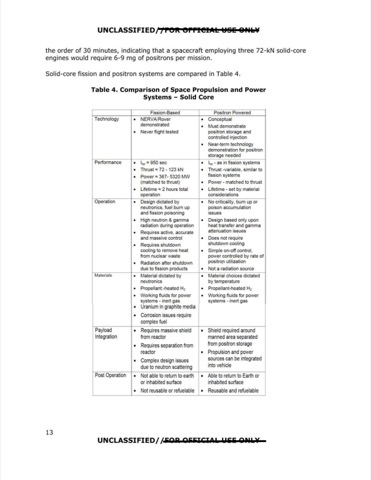
Image from page 18 of DOW-UAP-D123, as released by war.gov
Image from page 18 of the PDF. Open the scan to see the whole page.

Cite this page

U.S. Department of War. "AAWSAP DIRD, Positron Aerospace Propulsion, March 2010" (DOW-UAP-D123). PURSUE Release 06, U.S. Department of War, September 18, 2026. https://www.war.gov/medialink/ufo/sept-18/release-06/assets/DOW-UAP-D123_AAWSAP-DIRD-Positron-Aerospace-Propulsion-March-2-2010.pdf. Declassified UAP, page 18, https://declassifieduap.org/r/dow-uap-d123-aawsap-dird-positron-aerospace-propulsion-march-2010/p/18. Accessed November 28, 2026.

This address shows page 18 on its own; /r/dow-uap-d123-aawsap-dird-positron-aerospace-propulsion-march-2010?page=18 opens the same page in the full reader. Both stay. How to cite.