DOW-UAP-D123

AAWSAP DIRD, Positron Aerospace Propulsion, March 2010, page 17

One page of a U.S. government record released under PURSUE, shown on its own with its text. The record page has the whole document, its catalog details and the scan.

Page
17 of 35
Agency
Department of War
Released
Release 06, September 18, 2026

Text of page 17

UNCLASSIFIED/ FOR OFFICIAL USE ONLY THE SOLID-CORE POSITRON ROCKET Figure 11 depicts a solid-core positron-powered rocket, similar in many regards to the NERVA nuclear-thermal concept. 29 H2 Flow Turbopump H2 Tank Attenuating HX Positron Trap Hot Bleed Line Figure 11. Solid-Core Positron Rocket Engine With a Hot-Bleed Configuration (courtesy Positronics Research LLC)30 The cryogenic hydrogen propellant is supplied from a storage tank through a high- pressure pump and routed to cool the regenerative nozzle, the casing of the heat exchanger, and the central positron target tubes. Ps enters the inlet plenum to the attenuator that is heated by gamma rays to high temperature. Hydrogen propellant passes through the attenuating matrix and is heated and exhausted through a nozzle to generate thrust. A small fraction of the hot exit propellant is bled off to a turbine that drives the high- pressure feed pump. The high-temperature bleed can either be mixed with cold hydrogen to reduce its temperature or directly fed to the turbine. If it is directly fed to the turbine, it must be made of materials that can withstand high temperatures. The bleed flow is exhausted from a turbine exit nozzle to space after driving the turbine. As with the NERVA system, the positron solid-core concept is thermally limited by materials in the heating chamber. The difference is that the fission system requires a reactor and complex machinery, whereas the positron system relies on Ps atoms injected upstream from a storage unit. This has two advantages. First, a reduction in the engine mass for a given thrust is realized; second, there is greater choice in materials to be used in the heating chamber. A thermal-fluids analysis was conducted to predict performance. A specific impulse of 920 seconds is attainable with chamber temperatures at 3,000 Kelvin. The corresponding thrust and power emulate fission systems. Mars trip burn times are on 12 UNCLASSIFIED//FOR OFFICIAL USE ONLY

Machine-read (OCR) from the scan by this archive; it can contain errors. The scan is the record.
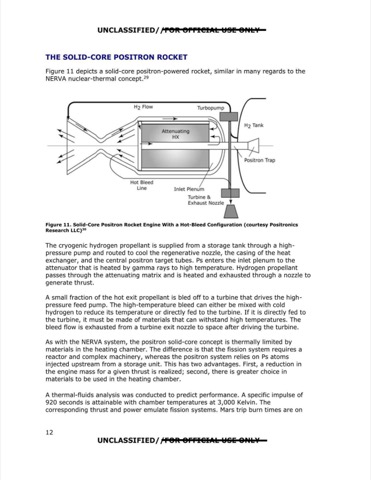
Image from page 17 of DOW-UAP-D123, as released by war.gov
Image from page 17 of the PDF. Open the scan to see the whole page.

Cite this page

U.S. Department of War. "AAWSAP DIRD, Positron Aerospace Propulsion, March 2010" (DOW-UAP-D123). PURSUE Release 06, U.S. Department of War, September 18, 2026. https://www.war.gov/medialink/ufo/sept-18/release-06/assets/DOW-UAP-D123_AAWSAP-DIRD-Positron-Aerospace-Propulsion-March-2-2010.pdf. Declassified UAP, page 17, https://declassifieduap.org/r/dow-uap-d123-aawsap-dird-positron-aerospace-propulsion-march-2010/p/17. Accessed November 28, 2026.

This address shows page 17 on its own; /r/dow-uap-d123-aawsap-dird-positron-aerospace-propulsion-march-2010?page=17 opens the same page in the full reader. Both stay. How to cite.