Text of page 22
UNCLASSIFIED//FeR eFFre
I UsE ONLY
A
C
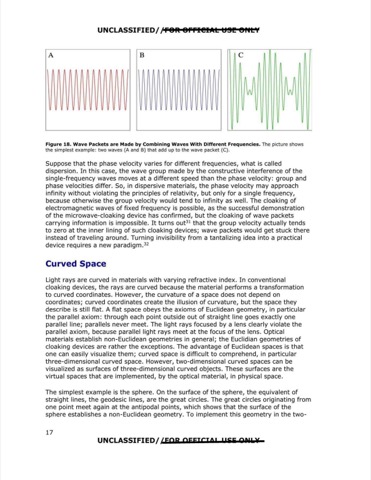
Figure 18. Wave Packets are Made by Combining Waves With Different Frequencies. The picture shows
the simplest example: two waves (A and B) that add up to the wave packet (C).
Suppose that the phase velocity varies for different frequencies, what is called
dispersion. In this case, the wave group made by the constructive interference of the
single-frequency waves moves at a different speed than the phase velocity: group and
phase velocities differ. So, in dispersive materials, the phase velocity may approach
infinity without violating the principles of relativity, but only for a single frequency,
because otherwise the group velocity would tend to infinity as well. The cloaking of
electromagnetic waves of fixed frequency is possible, as the successful demonstration
of the microwave-cloaking device has confirmed, but the cloaking of wave packets
carrying information is impossible. It turns out31 that the group velocity actually tends
to zero at the inner lining of such cloaking devices; wave packets would get stuck there
instead of traveling around. Turning invisibility from a tantalizing idea into a practical
device requires a new paradigm. 32
Curved Space
Light rays are curved in materials with varying refractive index. In conventional
cloaking devices, the rays are curved because the material performs a transformation
to curved coordinates. However, the curvature of a space does not depend on
coordinates; curved coordinates create the illusion of curvature, but the space they
describe is still flat. A flat space obeys the axioms of Euclidean geometry, in particular
the parallel axiom: through each point outside out of straight line goes exactly one
parallel line; parallels never meet. The light rays focused by a lens clearly violate the
parallel axiom, because parallel light rays meet at the focus of the lens. Optical
materials establish non-Euclidean geometries in general; the Euclidian geometries of
cloaking devices are rather the exceptions. The advantage of Euclidean spaces is that
one can easily visualize them; curved space is difficult to comprehend, in particular
three-dimensional curved space. However, two-dimensional curved spaces can be
visualized as surfaces of three-dimensional curved objects. These surfaces are the
virtual spaces that are implemented, by the optical material, in physical space.
The simplest example is the sphere. On the surface of the sphere, the equivalent of
straight lines, the geodesic lines, are the great circles. The great circles originating from
one point meet again at the antipodal points, which shows that the surface of the
sphere establishes a non-Euclidean geometry. To implement this geometry in the two-
17
UNCLASSIFIED/ /FOR OFFICIAL USE ONLY