Text of page 21
UNCLASSIFIED//F
AL USE ONLY
B
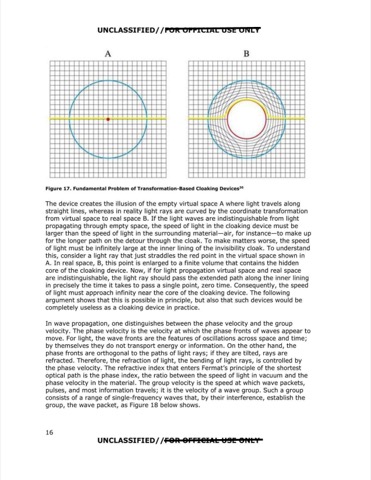
Figure 17. Fundamental Problem of Transformation-Based Cloaking Devices30
The device creates the illusion of the empty virtual space A where light travels along
straight lines, whereas in reality light rays are curved by the coordinate transformation
from virtual space to real space B. If the light waves are indistinguishable from light
propagating through empty space, the speed of light in the cloaking device must be
larger than the speed of light in the surrounding material-air, for instance-to make up
for the longer path on the detour through the cloak. To make matters worse, the speed
of light must be infinitely large at the inner lining of the invisibility cloak. To understand
this, consider a light ray that just straddles the red point in the virtual space shown in
A. In real space, B, this point is enlarged to a finite volume that contains the hidden
core of the cloaking device. Now, if for light propagation virtual space and real space
are indistinguishable, the light ray should pass the extended path along the inner lining
in precisely the time it takes to pass a single point, zero time. Consequently, the speed
of light must approach infinity near the core of the cloaking device. The following
argument shows that this is possible in principle, but also that such devices would be
completely useless as a cloaking device in practice.
In wave propagation, one distinguishes between the phase velocity and the group
velocity. The phase velocity is the velocity at which the phase fronts of waves appear to
move. For light, the wave fronts are the features of oscillations across space and time;
by themselves they do not transport energy or information. On the other hand, the
phase fronts are orthogonal to the paths of light rays; if they are tilted, rays are
refracted. Therefore, the refraction of light, the bending of light rays, is controlled by
the phase velocity. The refractive index that enters Fermat's principle of the shortest
optical path is the phase index, the ratio between the speed of light in vacuum and the
phase velocity in the material. The group velocity is the speed at which wave packets,
pulses, and most information travels; it is the velocity of a wave group. Such a group
consists of a range of single-frequency waves that, by their interference, establish the
group, the wave packet, as Figure 18 below shows.
16
UNCLASSIFIED//FOR OFFICIAL USE ONLY