Text of page 32
UNCLASSIFIED//FOR
AL USE ONLY
Dialysis works on the principles of
natural diffusion of metabolic waste
products in the blood across a
semipermeable membrane. Waste
products in high concentration in the
blood will diffuse across the
membrane. The membrane allows the
passage of certain-sized molecules
across it but prevents the passage of
other, larger molecules of the blood,
thus helping to get rid of waste
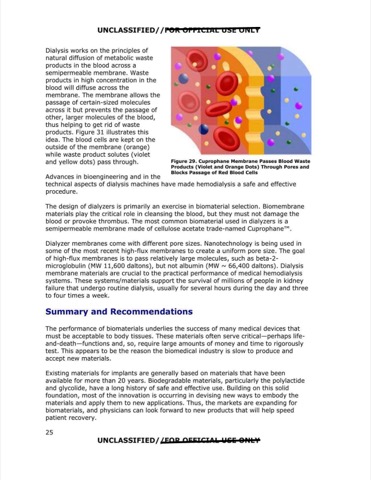
products. Figure 31 illustrates this
idea. The blood cells are kept on the
outside of the membrane (orange)
while waste product solutes (violet
and yellow dots) pass through.
Figure 29. Cuprophane Membrane Passes Blood Waste
Products (Violet and Orange Dots) Through Pores and
Blocks Passage of Red Blood Cells
Advances in bioengineering and in the
technical aspects of dialysis machines have made hemodialysis a safe and effective
procedure.
The design of dialyzers is primarily an exercise in biomaterial selection. Biomembrane
materials play the critical role in cleansing the blood, but they must not damage the
blood or provoke thrombus. The most common biomaterial used in dialyzers is a
semipermeable membrane made of cellulose acetate trade-named CuprophaneT™
Dialyzer membranes come with different pore sizes. Nanotechnology is being used in
some of the most recent high-flux membranes to create a uniform pore size. The goal
of high-flux membranes is to pass relatively large molecules, such as beta-2-
microglobulin (MW 11,600 daltons), but not albumin (MW ~ 66,400 daltons). Dialysis
membrane materials are crucial to the practical performance of medical hemodialysis
systems. These systems/materials support the survival of millions of people in kidney
failure that undergo routine dialysis, usually for several hours during the day and three
to four times a week.
Summary and Recommendations
The performance of biomaterials underlies the success of many medical devices that
must be acceptable to body tissues. These materials often serve critical-perhaps life-
and-death-functions and, so, require large amounts of money and time to rigorously
test. This appears to be the reason the biomedical industry is slow to produce and
accept new materials.
Existing materials for implants are generally based on materials that have been
available for more than 20 years. Biodegradable materials, particularly the polylactide
and glycolide, have a long history of safe and effective use. Building on this solid
foundation, most of the innovation is occurring in devising new ways to embody the
materials and apply them to new applications. Thus, the markets are expanding for
biomaterials, and physicians can look forward to new products that will help speed
patient recovery.
25
UNCLASSIFIED/ LEOR DEEICIAL USE ONLY