DOW-UAP-D119

AAWSAP DIRD, Biomaterials, January 2010, page 31

One page of a U.S. government record released under PURSUE, shown on its own with its text. The record page has the whole document, its catalog details and the scan.

Page
31 of 32
Agency
Department of War
Released
Release 06, September 18, 2026

Text of page 31

UNCLASSIFIED//FOR OF AL USE ONLY Another recent discovery is that treating the titanium surface with a silane compound will create a surface chemistry that attracts certain biomaterials known as proteoglycans. From this point, it is possible to lay down layers of collagen on the surface from which connective tissues will form. Titanium metal used for implants is usually a biomedical alloy, Ti-6Al-4V, since biomedical alloys provide good corrosion resistance and reasonable fatigue life and are much stiffer than cortical bone. The Ti-6AI-4V alloy is more suitable than is the Co-Cr alloy for coating with HA because it has less potential proximal stress shielding and bone resorption. BIOMATERIALS IN DIALYSIS Medical therapeutic dialysis, often called hemodialysis, is a method of removing uric acid and other waste products from blood, a necessity when the kidneys fail. It is also useful in removing exogenous poisons like ethanol, aspirin, barbiturates, and boric acid from the blood in cases of poisoning. Hemodialysis accesses the blood stream through the use of two large needles-one in an artery and one in a vein—in order to flow a patient's blood through a series of hair- thin, hollow-membrane, tube-like fibers. A dialyzer is composed of thousands of tube-like hollow fiber strands encased in a clear plastic cylinder several inches in diameter. Blood flows on the inside of the membrane fiber, and a dialysate (extraction stream) flows across the outside. Low-molecular- weight waste products pass out through the membrane, while blood cells and other large molecules in the blood are retained. Figure 30 shows an illustration (left) and photograph (right) of dialyzers used to treat kidney failure. Blood inlet Header Tube sheet Solution outlet Fibers Jacket Solution inlet Blood outlet Figure 28. Illustration (Left) and Photograph (Right) of a Blood Dialyzer as Used in Medicine 24 UNCLASSIFIED/ / FOR OFFIC AL USE ONLY

Machine-read (OCR) from the scan by this archive; it can contain errors. The scan is the record.
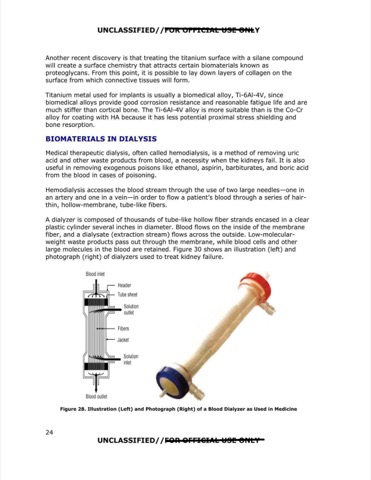
Image from page 31 of DOW-UAP-D119, as released by war.gov
Image from page 31 of the PDF. Open the scan to see the whole page.

Cite this page

U.S. Department of War. "AAWSAP DIRD, Biomaterials, January 2010" (DOW-UAP-D119). PURSUE Release 06, U.S. Department of War, September 18, 2026. https://www.war.gov/medialink/ufo/sept-18/release-06/assets/DOW-UAP-D119_AAWSAP-DIRD-Biomaterials-January-7-2010.pdf. Declassified UAP, page 31, https://declassifieduap.org/r/dow-uap-d119-aawsap-dird-biomaterials-january-2010/p/31. Accessed November 28, 2026.

This address shows page 31 on its own; /r/dow-uap-d119-aawsap-dird-biomaterials-january-2010?page=31 opens the same page in the full reader. Both stay. How to cite.