Text of page 14
UNCLASSIFIED/ / FOR OFFICIAL USE ONLY
Hot Face
N-Type -
Current In
Conductor
-P-Type
Current Out
Cold Face
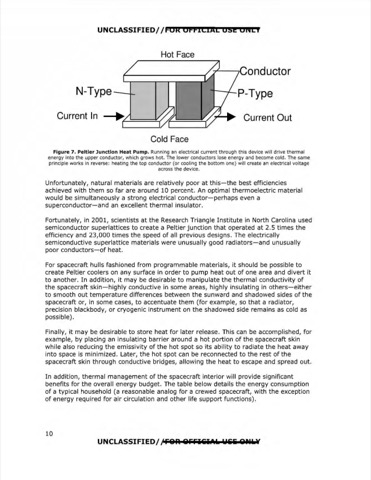
Figure 7. Peltier Junction Heat Pump. Running an electrical current through this device will drive thermal
ince into the in reversed near the top conductor or oring the or lose ne a create ame colic a votage
across the device.
Unfortunately, natural materials are relatively poor at this-the best efficiencies
achieved with them so far are around 10 percent. An optimal thermoelectric material
would be simultaneously a strong electrical conductor-perhaps even a
superconductor-and an excellent thermal insulator.
Fortunately, in 2001, scientists at the Research Triangle Institute in North Carolina used
semiconductor superlattices to create a Peltier junction that operated at 2.5 times the
efficiency and 23,000 times the speed of all previous designs. The electrically
semiconductive superlattice materials were unusually good radiators-and unusually
poor conductors-of heat.
For spacecraft hulls fashioned from programmable materials, it should be possible to
create Peltier coolers on any surface in order to pump heat out of one area and divert it
to another. In addition, it may be desirable to manipulate the thermal conductivity of
the spacecraft skin-highly conductive in some areas, highly insulating in others-either
to smooth out temperature differences between the sunward and shadowed sides of the
spacecraft or, in some cases, to accentuate them (for example, so that a radiator,
precision blackbody, or cryogenic instrument on the shadowed side remains as cold as
possible).
Finally, it may be desirable to store heat for later release. This can be accomplished, for
example, by placing an insulating barrier around a hot portion of the spacecraft skin
while also reducing the emissivity of the hot spot so its ability to radiate the heat away
into space is minimized. Later, the hot spot can be reconnected to the rest of the
spacecraft skin through conductive bridges, allowing the heat to escape and spread out.
In addition, thermal management of the spacecraft interior will provide significant
benefits for the overall energy budget. The table below details the energy consumption
of a typical household (a reasonable analog for a crewed spacecraft, with the exception
of energy required for air circulation and other life support functions).
10
UNCLASSIFIED/ /FOR OFFICIAL HISE-DAHLY