DOW-UAP-D117

AAWSAP DIRD, Metallic Glasses for Aerospace Applications, December 2009, page 17

One page of a U.S. government record released under PURSUE, shown on its own with its text. The record page has the whole document, its catalog details and the scan.

Page
17 of 30
Agency
Department of War
Released
Release 06, September 18, 2026

Text of page 17

UNCLASSIFIED//FOR OFFICIAL USL ONLY The subject of stress-corrosion cracking of metallic glasses, despite its obvious importance for structural applications, has received scant attention in the literature. What little work that has been done has focused on zirconium-based glasses, with the observation that these alloys are very susceptible to stress-corrosion cracking in aqueous environments containing chloride ions, likely owing to the fact that they do not form protective oxide surface layers.22 Mechanical Behavior at Elevated Temperature The discussion above relates to mechanical behavior at temperatures well below the glass transition temperature. At elevated temperatures, the strength drops and plastic deformation transitions to a homogeneous mode, occurring throughout the specimen instead of being localized into shear bands (Figure 6). Above the glass transition temperature, the alloy becomes a fluid, with a viscosity that drops exponentially with increasing temperature. Because the strength of the material is low, temperatures either above or below the glass transition may be useful for processing, as discussed above. However, the decrease in strength and the tendency for crystallization at elevated temperatures preclude use of metallic glasses from structural applications at temperatures approaching the glass transition temperature. 10'' Inhomogeneous deformation (shear localization) Normalized stress, t/u 10 Non-Newtonian Elastic (negligible flow) Homogeneous deformation 0.1 Newtonian 10-3 0.4 0.5 0.8 0.9 1 1.1 1.2 T/T, Figure 6. Deformation Map for Metallic Glasses. As a function of temperature (normalized to the glass transition temperature) and applied shear stress + (normalized to the shear modulus, ). At high stresses, plastic deformation occurs inhomogeneously, being localized into shear bands. At high temperatures, plastic deformation becomes homogeneous. The dashed lines represent different strain rates. The absolute stresses given are representative of the well-studied bulk metallic glass Zr41.2Ti13.8Cu12.5Ni10Be22.5, but the general features of the map are expected to apply to all metallic glasses. 23 11 UNCLASSIFIED/ /EO USE OILT

Machine-read (OCR) from the scan by this archive; it can contain errors. The scan is the record.
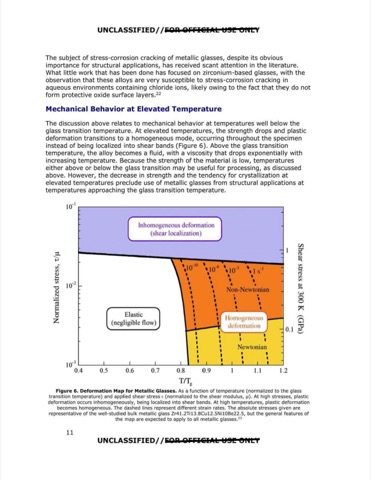
Image from page 17 of DOW-UAP-D117, as released by war.gov
Image from page 17 of the PDF. Open the scan to see the whole page.

Cite this page

U.S. Department of War. "AAWSAP DIRD, Metallic Glasses for Aerospace Applications, December 2009" (DOW-UAP-D117). PURSUE Release 06, U.S. Department of War, September 18, 2026. https://www.war.gov/medialink/ufo/sept-18/release-06/assets/DOW-UAP-D117_AAWSAP-DIRD-Metallic-Glasses-for-Aerospace-Applications-December-14-2009.pdf. Declassified UAP, page 17, https://declassifieduap.org/r/dow-uap-d117-aawsap-dird-metallic-glasses-for-aerospace-applications-december-2009/p/17. Accessed November 28, 2026.

This address shows page 17 on its own; /r/dow-uap-d117-aawsap-dird-metallic-glasses-for-aerospace-applications-december-2009?page=17 opens the same page in the full reader. Both stay. How to cite.