DOW-UAP-D117

AAWSAP DIRD, Metallic Glasses for Aerospace Applications, December 2009, page 16

One page of a U.S. government record released under PURSUE, shown on its own with its text. The record page has the whole document, its catalog details and the scan.

Page
16 of 30
Agency
Department of War
Released
Release 06, September 18, 2026

Text of page 16

UNCLASSIFIED//FOR OFFICIAL USE ONLY Stress amplitude/Ultimate tensile strength - 1,901 D Dendritic composite High-strength steel Single-phase metallic glass 2 0.01 - 103 104 105 10' T 10' 10% Number of cycles to failure Figure 5. Fatigue Limit of Metallic Glasses and Metallic-Glass-Matrix Composites. Fatigue life data for single-phase zirconium-based metallic glass (red) and a dendritic metallic glass matrix composite (blue). Representative data for steel (300-M) of similar tensile strength are shown for comparison. 17 18 19 Wear Resistance Because of their high yield strength, metallic glasses also have very high hardness. This, in turn, implies they might have good tribological behavior, which would be of particular interest when combined with the good corrosion resistance of some alloys (see below), opening up potential applications such as coatings on dry bearings for space applications.20 However, the tendency of metallic glasses to form shear bands and (in some cases) partially crystallize owing to deformation means their wear resistance is perhaps not as good as their high hardness would suggest. Nevertheless, the wear resistance of metallic glasses can still be quite good, and in fact one of the principal current markets for amorphous alloys is as wear- and corrosion-resistant coatings for tools such as drill bits. Corrosion and Stress-Corrosion Cracking It is frequently stated that metallic glasses have excellent corrosion resistance, but this is not always true. The lack of grain boundaries and second-phase particles makes some metallic glasses extremely resistant to corrosion, but this is not true of all alloys (some of which oxidize rapidly in air). Broadly speaking, the corrosion resistance of nickel- and iron-based metallic glasses is better than that of alloys based on zirconium, titanium, and copper (particularly in environments containing chloride ions).21 Some alloys are susceptible to localized pitting corrosion, probably facilitated by the presence of crystalline inclusions. 10 UNCLASSIFIED// FOR OFFICIAL LISE ONLY

Machine-read (OCR) from the scan by this archive; it can contain errors. The scan is the record.
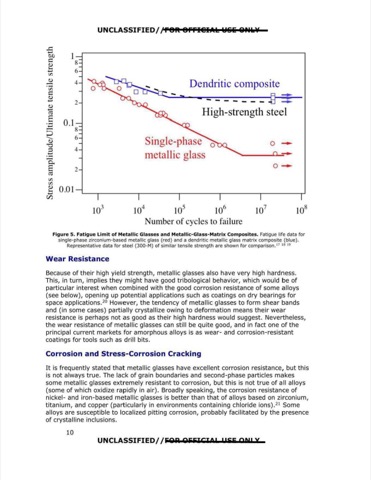
Image from page 16 of DOW-UAP-D117, as released by war.gov
Image from page 16 of the PDF. Open the scan to see the whole page.

Cite this page

U.S. Department of War. "AAWSAP DIRD, Metallic Glasses for Aerospace Applications, December 2009" (DOW-UAP-D117). PURSUE Release 06, U.S. Department of War, September 18, 2026. https://www.war.gov/medialink/ufo/sept-18/release-06/assets/DOW-UAP-D117_AAWSAP-DIRD-Metallic-Glasses-for-Aerospace-Applications-December-14-2009.pdf. Declassified UAP, page 16, https://declassifieduap.org/r/dow-uap-d117-aawsap-dird-metallic-glasses-for-aerospace-applications-december-2009/p/16. Accessed November 28, 2026.

This address shows page 16 on its own; /r/dow-uap-d117-aawsap-dird-metallic-glasses-for-aerospace-applications-december-2009?page=16 opens the same page in the full reader. Both stay. How to cite.