DOW-UAP-D117

AAWSAP DIRD, Metallic Glasses for Aerospace Applications, December 2009, page 14

One page of a U.S. government record released under PURSUE, shown on its own with its text. The record page has the whole document, its catalog details and the scan.

Page
14 of 30
Agency
Department of War
Released
Release 06, September 18, 2026

Text of page 14

UNCLASSIFIED/ / FOR €1 SE ONLT 200 pm Figure 4. Shear Bands. Produced by bending of a zirconium-based metallic glass. 14 Fracture Toughness Fracture toughness is a measure of a material's resistance to growth of cracks, a critical property for structural materials subjected to tensile loading. In very tough metals, the toughness usually results from plastic deformation that occurs near the tip of the advancing crack; plastic deformation requires energy, and the need to provide this energy translates into resistance to crack growth.3 Despite their lack of tensile ductility, at least some metallic glasses are not brittle in the same sense that ceramics are, for example, because they can experience significant plastic deformation around the crack tip during fracture. For instance, the fracture toughness (Kic) of zirconium-based metallic glasses is about 20 MPa m1/2 15-somewhat lower than the ~ 55 MPa m1/2 typical of crystalline zirconium alloys16 but much greater than the fracture toughness of ceramics (typically 1-5 MPa-m/2). The fact that metallic glasses are reasonably tough despite their lack of tensile ductility suggests structural applications are not out of the question. However, some metallic glasses appear to be intrinsically brittle in that they fracture with only limited plastic deformation near the crack top and thus have very low values of fracture toughness. For this reason, some alloys that would otherwise be highly desirable, such as iron-based metallic glasses (for their high strength and low cost) and magnesium-based glasses (for their low density), fall into this category. The physical origins of the difference between intrinsically brittle metallic glasses and those capable of limited plastic deformation (and thus some toughness) are not well understood. 3 In other materials, notably polymer-matrix composites, other mechanisms of toughening can be more important. 8 UNCLASSIFIED//FOR OFFICIAL USE ONLY

Machine-read (OCR) from the scan by this archive; it can contain errors. The scan is the record.
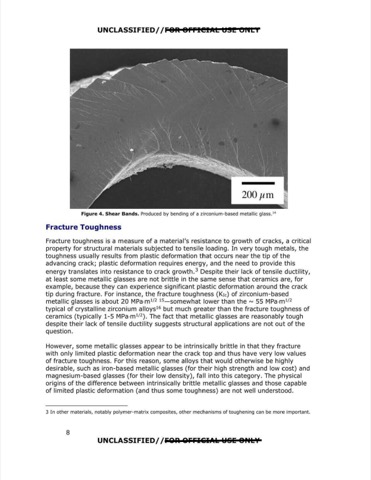
Image from page 14 of DOW-UAP-D117, as released by war.gov
Image from page 14 of the PDF. Open the scan to see the whole page.

Cite this page

U.S. Department of War. "AAWSAP DIRD, Metallic Glasses for Aerospace Applications, December 2009" (DOW-UAP-D117). PURSUE Release 06, U.S. Department of War, September 18, 2026. https://www.war.gov/medialink/ufo/sept-18/release-06/assets/DOW-UAP-D117_AAWSAP-DIRD-Metallic-Glasses-for-Aerospace-Applications-December-14-2009.pdf. Declassified UAP, page 14, https://declassifieduap.org/r/dow-uap-d117-aawsap-dird-metallic-glasses-for-aerospace-applications-december-2009/p/14. Accessed November 28, 2026.

This address shows page 14 on its own; /r/dow-uap-d117-aawsap-dird-metallic-glasses-for-aerospace-applications-december-2009?page=14 opens the same page in the full reader. Both stay. How to cite.